
Simplifying Expressions calculator

Simplify Expression Calculator for Equivalent Forms

A simplify expression calculator combines supported terms and rewrites expressions in equivalent forms. The displayed steps show how algebraic rules change each part.

  • Independent answer checks
  • Every step shown
  • Free, no sign-up

What math problem do you want to solve?

Ctrl+V pastes a screenshot · Shift+Enter: new line (one equation per line)

Try

Typed problems our engine solves stay in your browser. Photos, screenshots, PDFs and AI-helped problems are processed by our AI service — privacy.

Only like terms can be combined by adding coefficients. When a denominator contains a variable, its excluded values still matter.

Simplifying Expressions · worked example✓ Verified
4x−2(3−x)+74x - 2(3 - x) + 7
Start with the expression
4x−(2(3−x))+74x-(2(3-x))+7
Combine like terms
6x+16x+1
6x+16x+1Re-checked by a second engine
Simplifying Expressions · worked example✓ Verified
simplify 6x2+9x3x\text{simplify } \frac{6x^{2} + 9x}{3x}
Start with the expression
6(x2)+9x3x\frac{6(x^{2})+9x}{3x}
Combine like terms
2x+32x+3
2x+32x+3Re-checked by a second engine
Simplifying Expressions · worked example✓ Verified
(2a+3b)−(a−4b)(2a + 3b) - (a - 4b)
Start with the expression
2a+3b−(a−(4b))2a+3b-(a-(4b))
Combine like terms
a+7ba+7b
a+7ba+7bRe-checked by a second engine

1 / 3

Quick examples

Study guide

How to solve simplifying expressions

Simplifying means rewriting an expression in its shortest equivalent form. For pure arithmetic, follow the order of operations: parentheses first, then powers, then multiplication and division, then addition and subtraction.

In 2 + 3 × 4, the multiplication comes first even though the addition is written first: 3 × 4 = 12, then 2 + 12 = 14. Doing it left-to-right would wrongly give 20.

Parentheses override everything: in (2 + 3) × 4 you must add first (2 + 3 = 5), then multiply to get 20. The solver shows the parentheses step explicitly.

With variables, combine like terms — terms with the same variable part. In 2x + 3x, both terms are "x-terms", so they combine to 5x. But 2x + 3y cannot combine: different variables stay separate.

Unlike most AI tools that jump straight to the answer, this solver shows every operation as its own step, so you can follow the order of operations exactly.

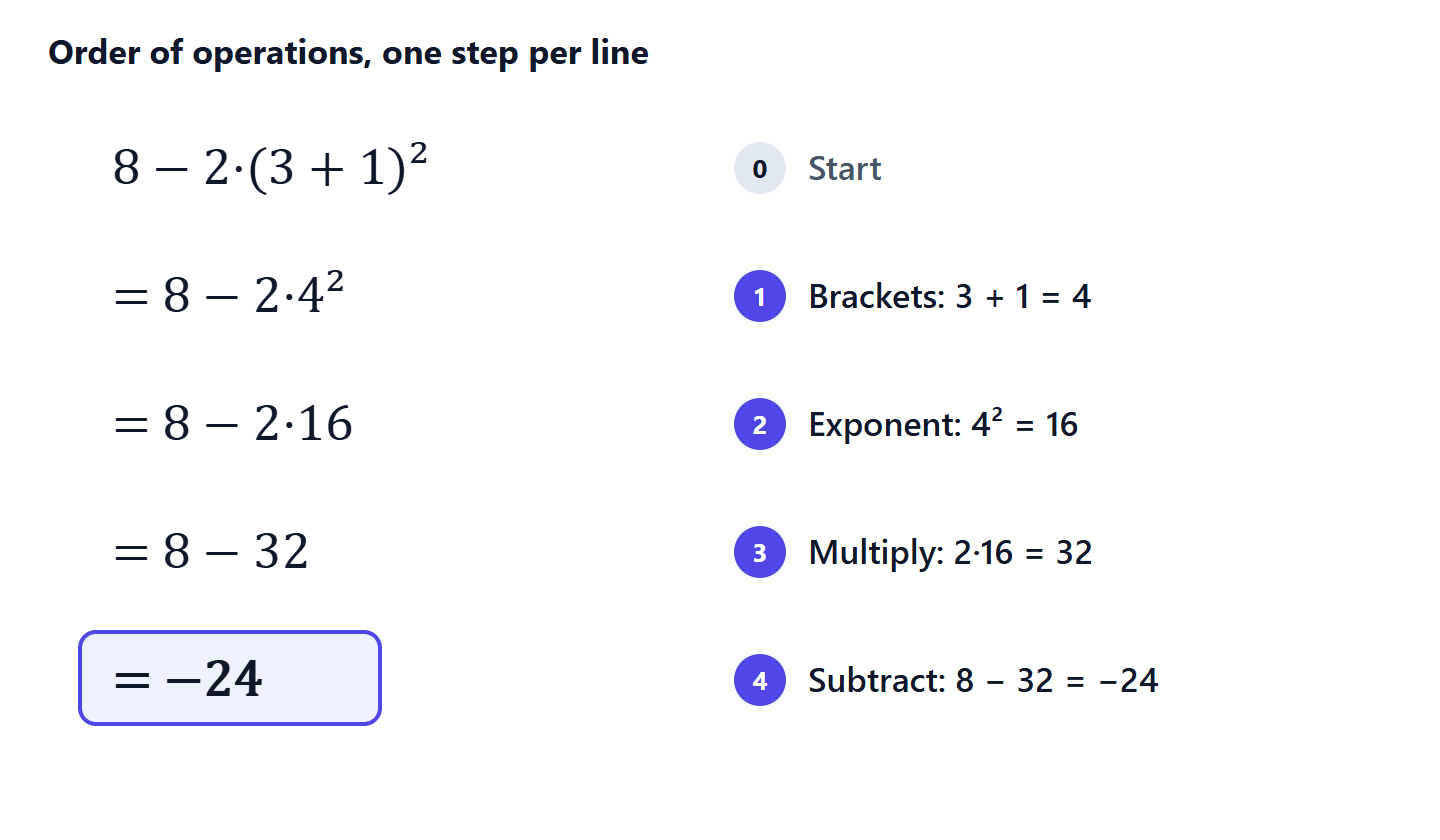
Order of operations ladder for 8 − 2·(3 + 1)²: brackets give 3 + 1 = 4, the exponent gives 4² = 16, multiplying gives 2·16 = 32, and subtracting gives 8 − 32 = −24.
One operation per line, in order — brackets, exponent, multiplication, then subtraction — turns 8 − 2·(3 + 1)² into −24.

Checking the result

How this result is checked

To check an equivalent form, the math engine compares original and simplified expressions at several allowed sample values. This numerical check is evidence, not a proof over every possible input.

What “simplest” means

What the simplify expression calculator counts as fully simplified

Teachers usually accept an expression as simplified when all four of these are true:

  1. There are no brackets left that could be multiplied out (unless the question wants factored form).
  2. No two terms are alike — every term has a different variable part.
  3. Numbers are combined into a single coefficient per term, and constants into one number.
  4. Any fraction has no common factor left between its numerator and denominator.

Order is a matter of taste: 6x+16x + 1 and 1+6x1 + 6x are the same expression. Most textbooks write the highest power first, which is how you should present the final answer.

Simplifying is usually a first step, not the last. When the expression is part of an equation to solve, continue in the AI math solver, and keep the common order of operations mistakes in mind — most wrong simplifications start with one of them.

Rational expressions

Cancelling factors, and the values that must stay excluded

In 6x2+9x3x\frac{6x^2 + 9x}{3x}, factor the top first (the factoring calculator shows the patterns): 3x(2x+3)3x(2x + 3). Now the common factor 3x3x cancels, leaving 2x+32x + 3.

But the original expression was undefined at x=0x = 0 (division by zero), and cancelling does not change that. The simplified form must carry the restriction x≠0x \neq 0 to be truly equivalent. The calculator always reports these restrictions under the answer.

Spotting every such value before you simplify is the same skill as finding where a function is defined; how to find the domain of a function covers denominators, square roots and logarithms one case at a time.

Terms are not factors

Cancel factors (things multiplied), never terms (things added). In x+3x\frac{x + 3}{x} nothing cancels.

Reference

Rules you use when simplifying

Order of operations

( ) → xn → × ÷ → + −(\,)\ \to\ x^n\ \to\ \times\,\div\ \to\ +\,-

Brackets, exponents, then multiplication and division left to right, then addition and subtraction.

Combining like terms

ax+bx=(a+b)xax + bx = (a + b)x

Only terms with the same variable and power.

Distributing a negative

−(a−b)=−a+b-(a - b) = -a + b

Every sign inside the bracket changes.

Product of powers

xm⋅xn=xm+nx^m \cdot x^n = x^{m+n}

Same base: add the exponents.

Worked examples

Simplifying Expressions, worked step by step

Each solution below is the solver’s own working, checked before it was published. Press “Solve it live” to open it in the calculator above.

Example 1 · A negative in front of a bracket

4x−2(3−x)+74x - 2(3 - x) + 7

The −2 multiplies both terms: −2⋅3=−6-2 \cdot 3 = -6 and −2⋅(−x)=+2x-2 \cdot (-x) = +2x.

6x+16x+1
✓ Verified

Independent check

x=1.7:original 11.2, answer 11.2x = 1.7:\quad \text{original } 11.2,\ \text{answer } 11.2
x=−2.3:original −12.8, answer −12.8x = -2.3:\quad \text{original } -12.8,\ \text{answer } -12.8
  1. Start with the expression
    4x−(2(3−x))+74x-(2(3-x))+7
    This is the expression to simplify.
  2. Combine like terms
    6x+16x+1
    Add and subtract matching terms and cancel where possible.

Example 2 · Two variables

(2a+3b)−(a−4b)(2a + 3b) - (a - 4b)

Subtracting a whole bracket changes the sign of each term inside it.

a+7ba+7b
✓ Verified
  1. Start with the expression
    2a+3b−(a−(4b))2a+3b-(a-(4b))
    This is the expression to simplify.
  2. Combine like terms
    a+7ba+7b
    Add and subtract matching terms and cancel where possible.

Example 3 · Order of operations

8−2⋅(3+1)28 - 2 \cdot (3 + 1)^{2}

Bracket first, then the square, then the multiplication — subtraction comes last.

−24-24
✓ Verified

Independent check

8−2⋅(3+1)2=−248-2\cdot \left(3+1\right)^{2} = -24

Working left to right instead gives 6⋅16=966 \cdot 16 = 96, a very different answer.

  1. Start with the expression
    8−(2((3+1)2))8-(2((3+1)^{2}))
    Follow the order of operations: parentheses first, then powers, then multiplication and division, then addition and subtraction.
  2. Add 3 + 1 = 4
    8−(2⋅(42))8 - (2 ⋅ (4 ^ 2))
    Parentheses come first in the order of operations.
  3. Power 4^2 = 16
    8−(2⋅16)8 - (2 ⋅ 16)
    Powers come before multiplication and division.
  4. Multiply 2 × 16 = 32
    8−328 - 32
    Parentheses come first in the order of operations.
  5. Subtract 8 − 32 = -24
    −24-24
    Addition and subtraction are done last, left to right.

Example 4 · Cancelling a common factor

simplify 6x2+9x3x\text{simplify } \frac{6x^{2} + 9x}{3x}

Factor the numerator, cancel 3x, keep the restriction.

2x+32x+3
✓ Verified

Restrictions: x ≠ 0

Independent check

x=1.7:original 6.4, answer 6.4x = 1.7:\quad \text{original } 6.4,\ \text{answer } 6.4
x=−2.3:original −1.6, answer −1.6x = -2.3:\quad \text{original } -1.6,\ \text{answer } -1.6
  1. Start with the expression
    6(x2)+9x3x\frac{6(x^{2})+9x}{3x}
    This is the expression to simplify.
  2. Combine like terms
    2x+32x+3
    Add and subtract matching terms and cancel where possible.

Avoid these

Common simplifying expressions mistakes

  • Combining unlike terms

    3x+2x23x + 2x^2 cannot be combined. Different powers of x are different kinds of term.

  • Half-distributing a minus

    −(a−4b)-(a - 4b) is −a+4b-a + 4b. The second sign flips too.

  • Squaring before the bracket

    In 2(3+1)22(3 + 1)^2, add inside the bracket first: 2⋅162 \cdot 16, not 2⋅(9+1)2 \cdot (9 + 1).

  • Cancelling terms

    x+66\frac{x + 6}{6} is not x+1x + 1. The 6 is a term on top, not a factor — a classic among common algebra mistakes.

  • Dropping restrictions

    After cancelling x, write x≠0x \neq 0 if the original had x in the denominator.

  • Treating ‑x² as (‑x)²

    −x2-x^2 means −(x2)-(x^2). With x = 3 it is −9, not 9.

FAQ

Simplifying Expressions calculator FAQ

What is the order of operations?

Parentheses, then exponents, then multiplication and division (left to right), then addition and subtraction (left to right). A common mnemonic is PEMDAS.

What are like terms?

Terms with identical variable parts, like 2x and 3x, or 4x² and −x². Only like terms can be combined by adding their coefficients: 2x+3x=5x.

Why is 2+3×4 equal to 14 and not 20?

Multiplication has higher precedence than addition, so 3×4 is evaluated first (12), then 2+12=14. Parentheses would change it: (2+3)×4=20.

Can like terms have different variables?

No. 2x and 3y are not like terms and cannot be combined — 2x+3y is already in simplest form.

How do I ask it to simplify rather than solve?

Type an expression with no equals sign, or start with the word simplify. With an equals sign the solver treats it as an equation and solves for the variable instead, as the linear equation calculator does.

Why did it leave my answer partly factored?

Sometimes a factored form is shorter — x(2x+7)x(2x + 7) rather than 2x2+7x2x^2 + 7x. Both are simplified; type expand before the expression if you need the multiplied-out form.

Can it simplify expressions with exponents and roots?

Yes — exponent rules, negative and fractional powers, and square roots are handled, with each rule shown as its own step.

Your own simplifying expressions problem

Expand, combine, cancel: paste the expression from your worksheet into the simplify expression calculator and check each rewrite against your own.