
Systems of Equations calculator

System of Equations Calculator for Shared Solutions

A system of equations calculator finds values that satisfy supported equations together. Follow the algebra to see how the unknowns are isolated.

  • Independent answer checks
  • Every step shown
  • Free, no sign-up

What math problem do you want to solve?

Ctrl+V pastes a screenshot · Shift+Enter: new line (one equation per line)

Try

Typed problems our engine solves stay in your browser. Photos, screenshots, PDFs and AI-helped problems are processed by our AI service — privacy.

Two lines can meet once, coincide, or never intersect. Those cases correspond to one solution, infinitely many solutions, or no solution.

Systems of Equations · worked example✓ Verified
y=2x−1;3x+y=9y = 2x - 1;\quad 3x + y = 9
Label the equations
(1)−2x+y=−1(2)3x+y=9(1) -2x + y = -1 (2) 3x + y = 9
Multiply equation (1) by 3
−6x+3y=−3-6x + 3y = -3
Multiply equation (2) by -2
−6x−2y=−18-6x - 2y = -18
x=2,y=3\displaystyle x = 2,\allowbreak y = 3Re-checked by a second engine
Systems of Equations · worked example✓ Verified
4x−3y=6;2x+y=84x - 3y = 6;\quad 2x + y = 8
Label the equations
(1)4x−3y=6(2)2x+y=8(1) 4x - 3y = 6 (2) 2x + y = 8
Multiply equation (1) by 2
8x−6y=128x - 6y = 12
Multiply equation (2) by 4
8x+4y=328x + 4y = 32
x=3,y=2\displaystyle x = 3,\allowbreak y = 2Re-checked by a second engine
Systems of Equations · worked example✓ Verified
x+2y=4;2x+4y=8x + 2y = 4;\quad 2x + 4y = 8
Label the equations
(1)x+2y=4(2)2x+4y=8(1) x + 2y = 4 (2) 2x + 4y = 8
Check the coefficients
1⋅4−2⋅2=01 \cdot 4 - 2 \cdot 2 = 0
Multiply equation (1) by 2
2x+4y=82x + 4y = 8
Infinitely many solutions (the lines coincide)Re-checked by a second engine

1 / 3

Quick examples

Study guide

How to solve systems of equations

A system of two equations in x and y has one solution: the point where the two lines cross. Your job is to find the x and y that satisfy both equations at once.

Elimination is usually fastest. Line the equations up and add or subtract them to cancel one variable. For x + y = 5 and 2x − y = 1, adding eliminates y immediately: 3x = 6, so x = 2.

Substitution works well when one variable is already isolated. Solve one equation for y, then plug that expression into the other equation — now you have one equation in x alone.

After finding one variable, substitute it back into either original equation to find the other. Then check the pair in both equations: (2, 3) must satisfy 2(2)+3(3)=13... wait, it must satisfy each original equation exactly.

Watch for special cases: parallel lines never meet (no solution), and identical lines meet everywhere (infinitely many solutions). The solver tells you plainly which case you have.

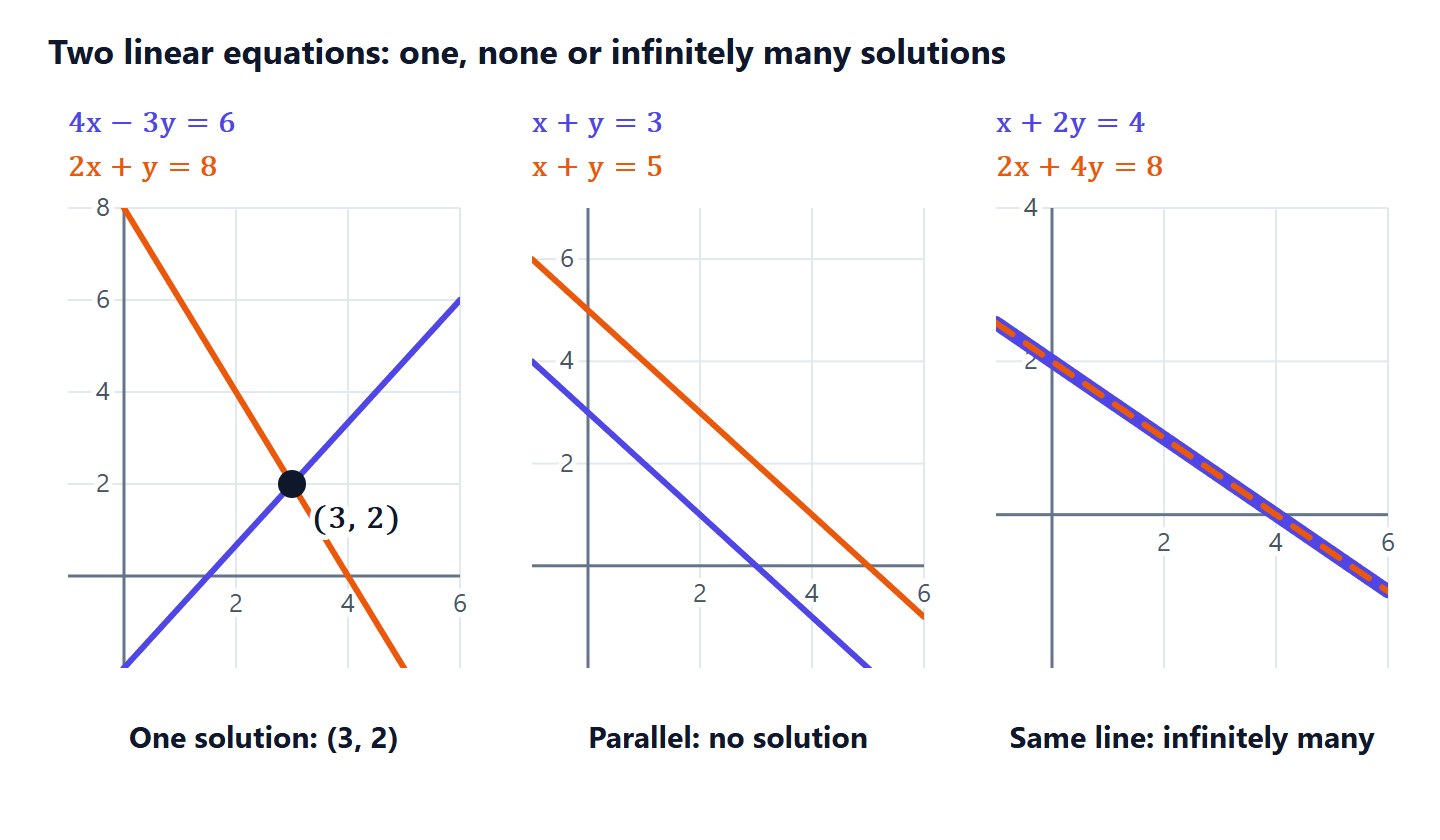
Three small graphs. Left: lines 4x − 3y = 6 and 2x + y = 8 cross at (3, 2), one solution. Middle: parallel lines x + y = 3 and x + y = 5 never meet, no solution. Right: x + 2y = 4 and 2x + 4y = 8 are the same line, infinitely many solutions.
The three outcomes for two linear equations: lines that cross (one solution), parallel lines (no solution) and the same line twice (infinitely many solutions).

Checking the result

How this result is checked

A candidate pair must satisfy both original equations. The math engine also uses separate checks for a dependent or inconsistent linear system.

Typing a system

How to enter two equations in the system of equations calculator

Put a semicolon between the equations — 4x - 3y = 6; 2x + y = 8 — or press Shift+Enter to start a new line for the second one. Either order works, and the equations do not have to be lined up in standard form: y = 2x - 1; 3x + y = 9 is read just as well.

Use x and y, or any two letters you like. If a variable is missing from one equation, that is fine: x + y = 10; x = 3 is a valid system whose second equation already gives x.

This calculator works with two equations. For three equations in three unknowns, separate them with semicolons in the AI math solver or the equation solver.

Choosing a method

Elimination or substitution?

Both methods always reach the same answer. The choice is about which one creates less arithmetic for the system in front of you:

  • Substitution is quickest when one equation already has a variable on its own, like y=2x−1y = 2x - 1. Replace y in the other equation and you are left with one equation in x.
  • Elimination is quickest when the coefficients line up, or can be made to with one multiplication. In 4x−3y=64x - 3y = 6 and 2x+y=82x + y = 8, multiplying the second equation by 3 gives +3y+3y to cancel the −3y-3y.

A third method, graphing, shows why there is one answer: each equation is a line, and the solution is where they cross. The AI math solver with a graph draws both lines with the intersection marked.

A fourth view uses matrices. Written as Ax=bA\mathbf{x} = \mathbf{b}, the system has exactly one solution when the determinant of the coefficient matrix is not zero; a zero determinant means the lines are parallel or the same line. Computing that determinant first tells you whether to expect a single crossing point before you start eliminating.

Reference

What the answer can look like

A linear 2×2 system has exactly one of three outcomes. You can tell which from the slopes before solving.

One solution

a1a2≠b1b2\frac{a_1}{a_2} \neq \frac{b_1}{b_2}

Different slopes: the lines cross at a single point.

No solution

a1a2=b1b2≠c1c2\frac{a_1}{a_2} = \frac{b_1}{b_2} \neq \frac{c_1}{c_2}

Same slope, different intercepts: parallel lines never meet.

Infinitely many

a1a2=b1b2=c1c2\frac{a_1}{a_2} = \frac{b_1}{b_2} = \frac{c_1}{c_2}

One equation is a multiple of the other: the same line twice.

Worked examples

Systems of Equations, worked step by step

Each solution below is the solver’s own working, checked before it was published. Press “Solve it live” to open it in the calculator above.

Example 1 · Elimination after one multiplication

4x−3y=6;2x+y=84x - 3y = 6;\quad 2x + y = 8

Scale the second equation so the y-terms are opposites, then add.

x=3,y=2\displaystyle x = 3,\allowbreak y = 2
✓ Verified

Independent check

4⋅3−3⋅2=64\cdot 3-3\cdot 2 = 6
2⋅3+2=82\cdot 3+2 = 8
  1. Label the equations
    (1)4x−3y=6(2)2x+y=8(1) 4x - 3y = 6 (2) 2x + y = 8
    Work with the two equations as a labeled pair.
  2. Multiply equation (1) by 2
    8x−6y=128x - 6y = 12
    This lines up the x coefficients for elimination.
  3. Multiply equation (2) by 4
    8x+4y=328x + 4y = 32
    Now both equations have the same x coefficient.
  4. Subtract to eliminate x
    8x−6y=12−(8x+4y=32)8x - 6y = 12 - (8x + 4y = 32)
    The x terms cancel, leaving one equation in y alone.
  5. Solve for y
    −10y=−20→y=2-10y = -20 → y = 2
    Divide by the coefficient, just like a one-variable equation.
  6. Substitute y = 2 into equation (1)
    4x−3(2)=64x - 3(2) = 6
    With one variable known, the other follows from either original equation.
  7. Solve for x
    x=3x = 3
    Simplify to get the final value.

Example 2 · Substitution

y=2x−1;3x+y=9y = 2x - 1;\quad 3x + y = 9

The first equation already isolates y — substitute it straight into the second.

x=2,y=3\displaystyle x = 2,\allowbreak y = 3
✓ Verified

Independent check

3=2⋅2−13 = 2\cdot 2-1
3⋅2+3=93\cdot 2+3 = 9
  1. Label the equations
    (1)−2x+y=−1(2)3x+y=9(1) -2x + y = -1 (2) 3x + y = 9
    Work with the two equations as a labeled pair.
  2. Multiply equation (1) by 3
    −6x+3y=−3-6x + 3y = -3
    This lines up the x coefficients for elimination.
  3. Multiply equation (2) by -2
    −6x−2y=−18-6x - 2y = -18
    Now both equations have the same x coefficient.
  4. Subtract to eliminate x
    −6x+3y=−3−(−6x−2y=−18)-6x + 3y = -3 - (-6x - 2y = -18)
    The x terms cancel, leaving one equation in y alone.
  5. Solve for y
    5y=15→y=35y = 15 → y = 3
    Divide by the coefficient, just like a one-variable equation.
  6. Substitute y = 3 into equation (1)
    −2x+(3)=−1-2x + (3) = -1
    With one variable known, the other follows from either original equation.
  7. Solve for x
    x=2x = 2
    Simplify to get the final value.

Example 3 · Parallel lines

x+y=3;x+y=5x + y = 3;\quad x + y = 5

Two quantities cannot add to 3 and 5 at the same time.

No solution (the lines are parallel)
✓ Verified

Independent check

The point (0,3) on line (1) gives (0)+(3)=3≠5 in (2), and the slopes are equal, so the lines never meet.\text{The point } (0, 3) \text{ on line (1) gives } (0) + (3) = 3 \ne 5 \text{ in (2), and the slopes are equal, so the lines never meet.}

Subtracting the equations gives 0 = 2, a contradiction: no solution.

  1. Label the equations
    (1)x+y=3(2)x+y=5(1) x + y = 3 (2) x + y = 5
    Work with the two equations as a labeled pair.
  2. Check the coefficients
    1⋅1−1⋅1=01 \cdot 1 - 1 \cdot 1 = 0
    The cross-products of the x and y coefficients are equal, so the left-hand sides are multiples of each other: the lines have the same slope.
  3. Subtract to eliminate both variables
    0=20 = 2
    Both x and y cancel and what is left, 0 = 2, is false: the lines are parallel and never meet, so no pair of values satisfies both.

Example 4 · The same line twice

x+2y=4;2x+4y=8x + 2y = 4;\quad 2x + 4y = 8

The second equation is exactly twice the first.

Infinitely many solutions (the lines coincide)
✓ Verified

Independent check

The point (0,2) on line (1) also satisfies (2): 2(0)+4(2)=8\text{The point } (0, 2) \text{ on line (1) also satisfies (2): } 2(0) + 4(2) = 8
The point (1,3/2) on line (1) also satisfies (2): 2(1)+4(3/2)=8\text{The point } (1, 3/2) \text{ on line (1) also satisfies (2): } 2(1) + 4(3/2) = 8

Every point on the line x + 2y = 4 is a solution, so the answer is "infinitely many solutions".

  1. Label the equations
    (1)x+2y=4(2)2x+4y=8(1) x + 2y = 4 (2) 2x + 4y = 8
    Work with the two equations as a labeled pair.
  2. Check the coefficients
    1⋅4−2⋅2=01 \cdot 4 - 2 \cdot 2 = 0
    The cross-products of the x and y coefficients are equal, so the left-hand sides are multiples of each other: the lines have the same slope.
  3. Multiply equation (1) by 2
    2x+4y=82x + 4y = 8
    Now the left-hand side matches equation (2) exactly.
  4. Subtract to eliminate both variables
    0=00 = 0
    Both x and y cancel and what is left, 0 = 0, is always true: the two equations describe the same line, so every point on it is a solution.
  5. Describe the solutions
    x=−2y+4x = -2y + 4
    Every pair (x, y) on this line is a solution: choose either value and the equation gives the other.

Avoid these

Common systems of equations mistakes

  • Multiplying only one side

    Scaling an equation for elimination means multiplying every term, including the number on the right.

  • Adding when you should subtract

    If the coefficients have the same sign (2y and 2y), subtract to eliminate. Opposite signs (2y and −2y), add.

  • Stopping after one variable

    Finding x = 3 is half the answer. Substitute back to find y, and give the solution as a pair.

  • Checking in one equation only

    A pair that satisfies the equation you substituted into can still fail the other. Check both.

  • Reading 0 = 0 as "no answer"

    0 = 0 after elimination means the equations describe the same line — infinitely many solutions, not none.

  • Substituting into the same equation

    If you solved equation 1 for y, substitute into equation 2. Putting it back into equation 1 always gives a true but useless statement.

FAQ

Systems of Equations calculator FAQ

What is the elimination method?

Add or subtract the two equations to cancel one variable. With x+y=5 and 2x−y=1, adding gives 3x=6, so x=2; then y=3 from either equation.

What is the substitution method?

Solve one equation for one variable, then substitute that expression into the other equation. It is ideal when a variable already has coefficient 1 or −1.

How do you check a system solution?

Plug the (x, y) pair into both original equations — both must balance. Our solver substitutes into both equations automatically before verifying.

Can a system have no solution?

Yes. If the lines are parallel (same slope, different intercept), they never intersect — for example x+y=2 and x+y=5. The solver reports "No solution" instead of guessing.

Can it solve three equations in three unknowns?

Yes. Type the three equations separated by semicolons — x + y + z = 6; x - y + z = 2; 2x + y - z = 1 — and the full math engine in your browser solves them, checking the values in all three before marking ✓ Verified. For matrix methods, see the AI matrix solver.

How do I write the answer?

As an ordered pair, (x,y)(x, y) — for example (3,2)(3, 2) — or as "x = 3, y = 2". For parallel lines write "no solution"; for coinciding lines, "infinitely many solutions".

Can I use it for word problems with two unknowns?

Yes — ticket prices, coin mixes and two-speed problems usually give two equations. Write them yourself, or paste the story into the AI word problem solver and confirm the system it proposes.

Your own systems of equations problem

Separate your two equations with a semicolon, choose elimination or substitution, and the system of equations calculator checks the pair in both.