
Derivatives calculator

Derivative Calculator for Rates of Change

A derivative calculator finds derivatives of supported functions and displays the applied rules. The result describes the instantaneous rate of change where the derivative exists.

  • Independent answer checks
  • Every step shown
  • Free, no sign-up

What math problem do you want to solve?

Ctrl+V pastes a screenshot · Shift+Enter: new line (one equation per line)

Try

Typed problems our engine solves stay in your browser. Photos, screenshots, PDFs and AI-helped problems are processed by our AI service — privacy.

For a composite function, the chain rule multiplies the outer derivative by the inner derivative. Products and quotients may require additional rules.

Derivatives · worked example✓ Verified
ddxe3xcos⁡(x)\frac{d}{dx} e^{3x} \cos(x)
Differentiate with respect to x
ddx[(e(3⋅x))⋅cos⁡(x)]\frac{d}{dx} [(e ^ (3 \cdot x)) \cdot \cos(x)]
Apply the product rule
((e(3⋅x)))′(cos⁡(x))+((e(3⋅x)))(cos⁡(x))′\displaystyle ((e ^ (3 \cdot x)))'(\cos(x)) + ((e ^ (3 \cdot x)))(\cos(x))'
Find each part
f′=3e3x,g′=−sin⁡(x)\displaystyle f' = 3e^{3x},\allowbreak g' = -\sin(x)
3e3x⋅cos⁡(x)−e3x⋅sin⁡(x)3e^{3x} \cdot \cos(x)-e^{3x} \cdot \sin(x)Re-checked by a second engine
Derivatives · worked example✓ Verified
ddx(2x+1)4\frac{d}{dx} (2x+1)^{4}
Differentiate with respect to x
ddx[(2⋅x+1)4]\frac{d}{dx} [(2 \cdot x + 1) ^ 4]
Apply the power rule
ddx[x4]=4⋅x4−1\frac{d}{dx}[x^{4}] = 4 \cdot x^{4 - 1}
Simplify
8(2x+1)38(2x+1)^{3}
8(2x+1)38(2x+1)^{3}Re-checked by a second engine
Derivatives · worked example✓ Verified
ddxtan⁡(x)\frac{d}{dx} \tan(x)
Differentiate with respect to x
ddx[tan⁡(x)]\frac{d}{dx} [\tan(x)]
Apply the chain rule
ddx[tan⁡(x)]=tan′(x)⋅ddx[x]\frac{d}{dx}[\tan(x)] = tan'(x) \cdot \frac{d}{dx}[x]
Differentiate the outer and inner parts
outer: sec⁡((x))2,inner: 1\displaystyle \allowbreak \text{outer: } \sec((x))^{2},\allowbreak \quad \allowbreak \text{inner: } 1
sec⁡(x)2\sec(x)^{2}Re-checked by a second engine

1 / 3

Quick examples

Study guide

How to solve derivatives

A derivative measures instantaneous rate of change — the slope of the tangent line at each point. The power rule handles the basics: the derivative of xⁿ is n·xⁿ⁻¹.

For x³, bring the 3 down and reduce the exponent by one: 3x². Constants differentiate to zero, and the derivative of x itself is 1.

Products need the product rule: (fg)′ = f′g + fg′. For x²·eˣ, that gives 2x·eˣ + x²·eˣ — differentiate each factor in turn and add the results.

Compositions need the chain rule: differentiate the outside, then multiply by the derivative of the inside. For sin(x²), the outside gives cos(x²) and the inside gives 2x, so the answer is 2x·cos(x²).

Quotients use the quotient rule: (f/g)′ = (f′g − fg′)/g². Keep the minus sign and the squared denominator — that is where most errors happen.

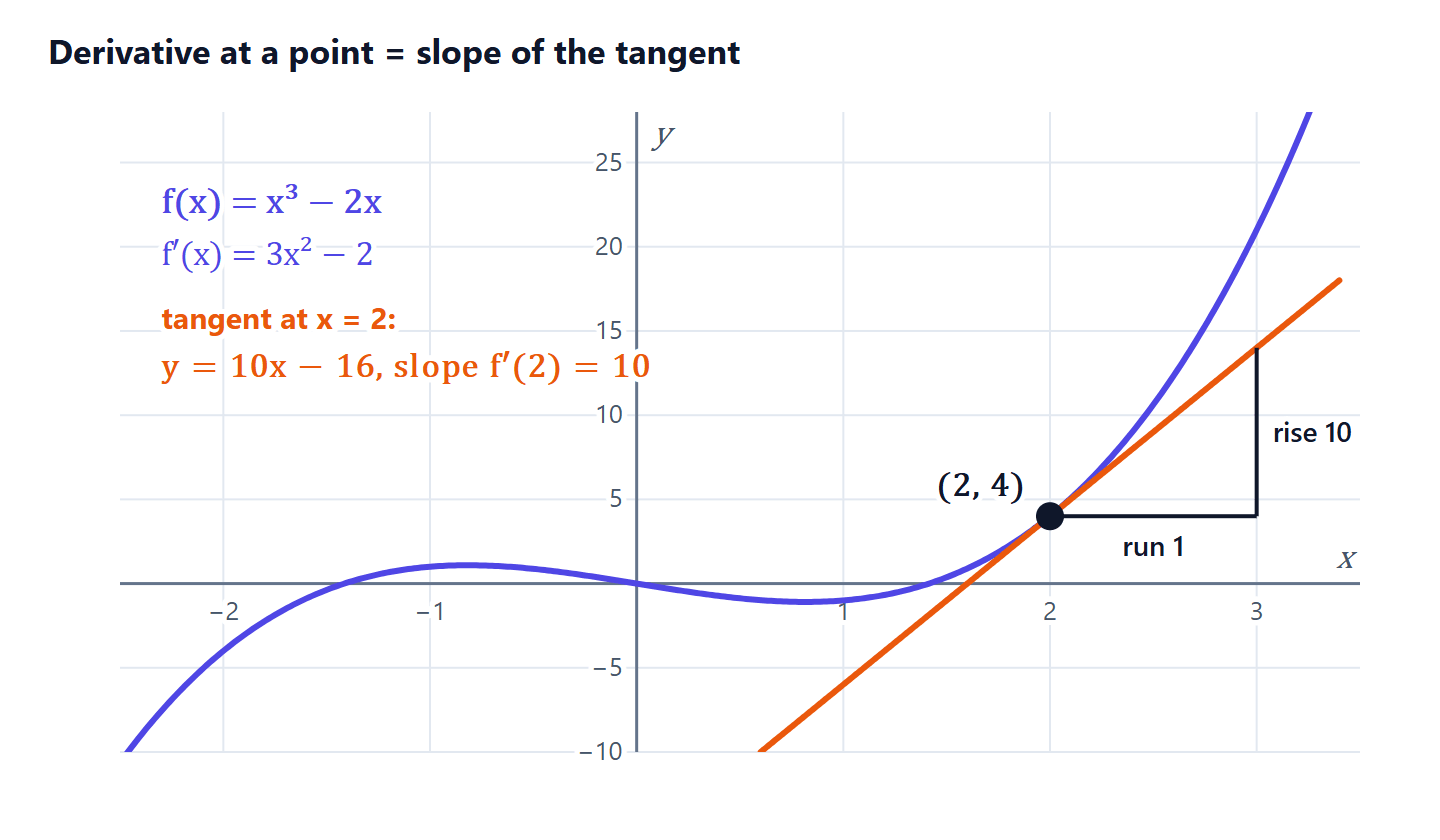
Graph of f(x) = x³ − 2x with its tangent line at the point (2, 4); the tangent is y = 10x − 16, whose slope 10 is the derivative f′(2).
The derivative at a point is the slope of the tangent there. For f(x) = x³ − 2x, f′(x) = 3x² − 2, so at x = 2 the slope is 10 and the tangent through (2, 4) is y = 10x − 16.

Checking the result

How this result is checked

For supported derivatives, the math engine compares the answer with numerical difference quotients of the original function. Sampling uses tolerances and does not prove a derivative everywhere.

Choosing the rule

Which differentiation rule do I need?

Look at the last operation you would do if you evaluated the function by hand. That operation decides the rule:

  • A sum or difference of terms → differentiate term by term, using the power rule on each power of x.
  • Two functions multiplied → product rule. e3xcos⁡xe^{3x}\cos x is a product.
  • One function divided by another → quotient rule (or rewrite as a product with a negative power).
  • A function inside another → the chain rule. (2x+1)4(2x + 1)^4 is "something to the fourth", with 2x+12x + 1 inside.

Real problems nest these: the product rule may need the chain rule for one of its factors. The calculator handles one layer per step so you can see where each piece comes from.

Notation

Writing derivatives for the derivative calculator

These all mean the same thing: dydx\frac{dy}{dx}, y′y', f′(x)f'(x) and ddxf(x)\frac{d}{dx}f(x). In the calculator, type d/dx and then the function. For a second derivative, differentiate the first result again. To go the other way, from a derivative back to the function, use the integral calculator.

Answers are simplified but not always in the textbook’s form — sec⁡2x\sec^2 x and 1+tan⁡2x1 + \tan^2 x, for instance, are equal. If your answer differs, check whether the two agree before assuming one is wrong.

When the derivative is only one step of a longer question, paste the whole question into the AI math solver instead. It reads the problem first, names each rule as it uses it, and marks the result Verified only if a supported check passes.

Reference

Derivatives worth memorizing

The rules on the calculus solver page combine with these standard derivatives. The derivative-rules deck of the math flashcards drills them.

Power

ddxxn=nxn−1\frac{d}{dx}x^n = nx^{n-1}

Exponential

ddxekx=kekx\frac{d}{dx}e^{kx} = ke^{kx}

Natural log

ddxln⁡x=1x\frac{d}{dx}\ln x = \frac{1}{x}

Sine and cosine

(sin⁡x)′=cos⁡x,(cos⁡x)′=−sin⁡x(\sin x)' = \cos x,\quad (\cos x)' = -\sin x

Tangent

ddxtan⁡x=sec⁡2x\frac{d}{dx}\tan x = \sec^2 x

Constant multiple

ddx[c f(x)]=c f′(x)\frac{d}{dx}[c\,f(x)] = c\,f'(x)

Constants come along for the ride; added constants vanish.

Worked examples

Derivatives, worked step by step

Each solution below is the solver’s own working, checked before it was published. Press “Solve it live” to open it in the calculator above.

Example 1 · A polynomial

ddx4x5−3x2+7\frac{d}{dx} 4x^{5} - 3x^{2} + 7

The power rule on each term; the constant 7 has derivative 0.

−6x+20x4-6x+20x^{4}
✓ Verified

Independent check

x=0.7:f′(0.7)=0.602 ≈ 0.6020000019 (difference quotient)x = 0.7:\quad f'(0.7) = 0.602\ \approx\ 0.6020000019\ \text{(difference quotient)}
x=1.7:f′(1.7)=156.842 ≈ 156.842 (difference quotient)x = 1.7:\quad f'(1.7) = 156.842\ \approx\ 156.842\ \text{(difference quotient)}
  1. Differentiate with respect to x
    ddx[4⋅(x5)−(3⋅(x2))+7]\frac{d}{dx} [4 \cdot (x ^ 5) - (3 \cdot (x ^ 2)) + 7]
    This is the derivative to find.
  2. Apply the sum rule
    ddx[4⋅(x5)−(3⋅(x2))]+ddx[7]\displaystyle \frac{d}{dx}[4 \cdot (x ^ 5) - (3 \cdot (x ^ 2))] + \frac{d}{dx}[7]
    The derivative of a sum is the sum of the derivatives.
  3. Differentiate each term
    −6x+20x4+0-6x+20x^{4} + 0
    Handle each term on its own, then combine.
  4. Simplify
    −6x+20x4-6x+20x^{4}
    Collect terms for the final answer.

Example 2 · Chain rule

ddx(2x+1)4\frac{d}{dx} (2x+1)^{4}

Bring down the 4, keep the bracket, then multiply by the derivative of 2x + 1.

8(2x+1)38(2x+1)^{3}
✓ Verified

Independent check

x=0.7:f′(0.7)=110.592 ≈ 110.592 (difference quotient)x = 0.7:\quad f'(0.7) = 110.592\ \approx\ 110.592\ \text{(difference quotient)}
x=1.7:f′(1.7)=681.472 ≈ 681.472 (difference quotient)x = 1.7:\quad f'(1.7) = 681.472\ \approx\ 681.472\ \text{(difference quotient)}
  1. Differentiate with respect to x
    ddx[(2⋅x+1)4]\frac{d}{dx} [(2 \cdot x + 1) ^ 4]
    This is the derivative to find.
  2. Apply the power rule
    ddx[x4]=4⋅x4−1\frac{d}{dx}[x^{4}] = 4 \cdot x^{4 - 1}
    Bring the exponent down front, then lower it by one.
  3. Simplify
    8(2x+1)38(2x+1)^{3}
    Collect terms for the final answer.

Example 3 · Product rule with a chain inside

ddxe3xcos⁡(x)\frac{d}{dx} e^{3x} \cos(x)

Two factors multiplied, and the first one needs the chain rule for its 3x.

3e3x⋅cos⁡(x)−e3x⋅sin⁡(x)3e^{3x} \cdot \cos(x)-e^{3x} \cdot \sin(x)
✓ Verified

Independent check

x=0.7:f′(0.7)=13.47670268 ≈ 13.47670268 (difference quotient)x = 0.7:\quad f'(0.7) = 13.47670268\ \approx\ 13.47670268\ \text{(difference quotient)}
x=1.7:f′(1.7)=−226.0547127 ≈ −226.0547128 (difference quotient)x = 1.7:\quad f'(1.7) = -226.0547127\ \approx\ -226.0547128\ \text{(difference quotient)}
  1. Differentiate with respect to x
    ddx[(e(3⋅x))⋅cos⁡(x)]\frac{d}{dx} [(e ^ (3 \cdot x)) \cdot \cos(x)]
    This is the derivative to find.
  2. Apply the product rule
    ((e(3⋅x)))′(cos⁡(x))+((e(3⋅x)))(cos⁡(x))′\displaystyle ((e ^ (3 \cdot x)))'(\cos(x)) + ((e ^ (3 \cdot x)))(\cos(x))'
    For f·g, the rule is f'g + fg'.
  3. Find each part
    f′=3e3x,g′=−sin⁡(x)\displaystyle f' = 3e^{3x},\allowbreak g' = -\sin(x)
    Differentiate the two factors separately.
  4. Put it together
    3e3x⋅(cos⁡(x))+((e(3⋅x)))⋅−sin⁡(x)3e^{3x} \cdot (\cos(x)) + ((e ^ (3 \cdot x))) \cdot -\sin(x)
    Assemble f'g + fg'.
  5. Simplify
    3e3x⋅cos⁡(x)−e3x⋅sin⁡(x)3e^{3x} \cdot \cos(x)-e^{3x} \cdot \sin(x)
    Collect terms for the final answer.

Example 4 · A trig derivative

ddxtan⁡(x)\frac{d}{dx} \tan(x)

A standard result — worth knowing by heart for every calculus test.

sec⁡(x)2\sec(x)^{2}
✓ Verified

Independent check

x=0.7:f′(0.7)=1.709449716 ≈ 1.709449716 (difference quotient)x = 0.7:\quad f'(0.7) = 1.709449716\ \approx\ 1.709449716\ \text{(difference quotient)}
x=1.7:f′(1.7)=60.23768449 ≈ 60.23768485 (difference quotient)x = 1.7:\quad f'(1.7) = 60.23768449\ \approx\ 60.23768485\ \text{(difference quotient)}
  1. Differentiate with respect to x
    ddx[tan⁡(x)]\frac{d}{dx} [\tan(x)]
    This is the derivative to find.
  2. Apply the chain rule
    ddx[tan⁡(x)]=tan′(x)⋅ddx[x]\frac{d}{dx}[\tan(x)] = tan'(x) \cdot \frac{d}{dx}[x]
    Differentiate the outer function, then multiply by the derivative of what is inside.
  3. Differentiate the outer and inner parts
    outer: sec⁡((x))2,inner: 1\displaystyle \allowbreak \text{outer: } \sec((x))^{2},\allowbreak \quad \allowbreak \text{inner: } 1
    Handle each layer on its own.
  4. Simplify
    sec⁡(x)2\sec(x)^{2}
    Collect terms for the final answer.

Example 5 · Derivative at a point

f(x)=x3−2x, find f′(2)f(x) = x^{3} - 2x, \text{ }\allowbreak \text{find } f'(2)

Differentiate first, then substitute the x-value: the number you get is the slope of the tangent line at that point.

1010
✓ Verified

Independent check

f(2.00001)−f(1.99999)0.00002≈10.00000≈10\frac{f(2.00001) - f(1.99999)}{0.00002} \approx 10.00000 \approx 10
  1. Differentiate with respect to x
    ddx[x3−(2⋅x)]\frac{d}{dx} [x ^ 3 - (2 \cdot x)]
    This is the derivative to find.
  2. Apply the sum rule
    ddx[x3]−ddx[(2⋅x)]\frac{d}{dx}[x ^ 3] - \frac{d}{dx}[(2 \cdot x)]
    The derivative of a sum is the sum of the derivatives.
  3. Differentiate each term
    3x2−23x^{2} - 2
    Handle each term on its own, then combine.
  4. Simplify
    −2+3x2-2+3x^{2}
    Collect terms for the final answer.
  5. Substitute x = 2
    f′(2)=−2+3(2)2=10f'(2) = -2+3(2)^{2} = 10
    The derivative gives the slope at every x: put in the x of the point.

Avoid these

Common derivatives mistakes

  • Forgetting the inside derivative

    The derivative of (2x+1)4(2x + 1)^4 is 4(2x+1)3⋅24(2x + 1)^3 \cdot 2. The ·2 is the chain rule, and it is the most-missed factor in calculus.

  • Multiplying derivatives for a product

    (uv)′(uv)' is u′v+uv′u'v + uv', not u′v′u'v'.

  • Quotient rule in the wrong order

    The numerator is u′v−uv′u'v - uv'. Swapping the terms flips the sign of the answer.

  • Differentiating the exponent wrongly

    ddxe3x\frac{d}{dx}e^{3x} is 3e3x3e^{3x}, not 3xe3x−13xe^{3x - 1}. The power rule does not apply to exponentials.

  • Losing the minus on cosine

    The derivative of cos⁡x\cos x is −sin⁡x-\sin x. Sine to cosine is positive; cosine to sine is negative.

  • Leaving a constant behind

    The derivative of a constant term is zero. +7+7 does not become +7x+7x or +1+1.

FAQ

Derivatives calculator FAQ

What is the power rule?

The derivative of xⁿ is n·xⁿ⁻¹. So d/dx of x³ is 3x², and d/dx of x⁵ is 5x⁴.

How does the chain rule work?

For a composition like sin(x²): differentiate the outer function (cos(x²)), then multiply by the derivative of the inner function (2x). Result: 2x·cos(x²).

What is the product rule?

(fg)′ = f′g + fg′. For x²·eˣ: 2x·eˣ + x²·eˣ. Differentiate each factor while holding the other fixed, then add.

What is the quotient rule?

(f/g)′ = (f′g − fg′)/g² — "low d-high minus high d-low, over low squared". Watch the subtraction order and the squared denominator.

How is the derivative verified?

The result is compared with a numerical derivative — the slope of the function measured over a tiny interval — at many sample points. Only if they agree everywhere is the answer marked ✓ Verified.

Can it do implicit differentiation?

Not as a dedicated method yet. For an equation like x2+y2=25x^2 + y^2 = 25, differentiate each side by hand and use the AI calculus solver to check the algebra that follows.

Can I find the derivative at a point?

Yes. Type the function and the point, for example f(x) = x^3 - 2x, find f'(2): the calculator differentiates first, then substitutes the x-value. The result is the slope of the tangent line at that point.

Your own derivatives problem

Type d/dx and your function into the derivative calculator — see which rule applies at each layer, and check your own derivative line by line.