


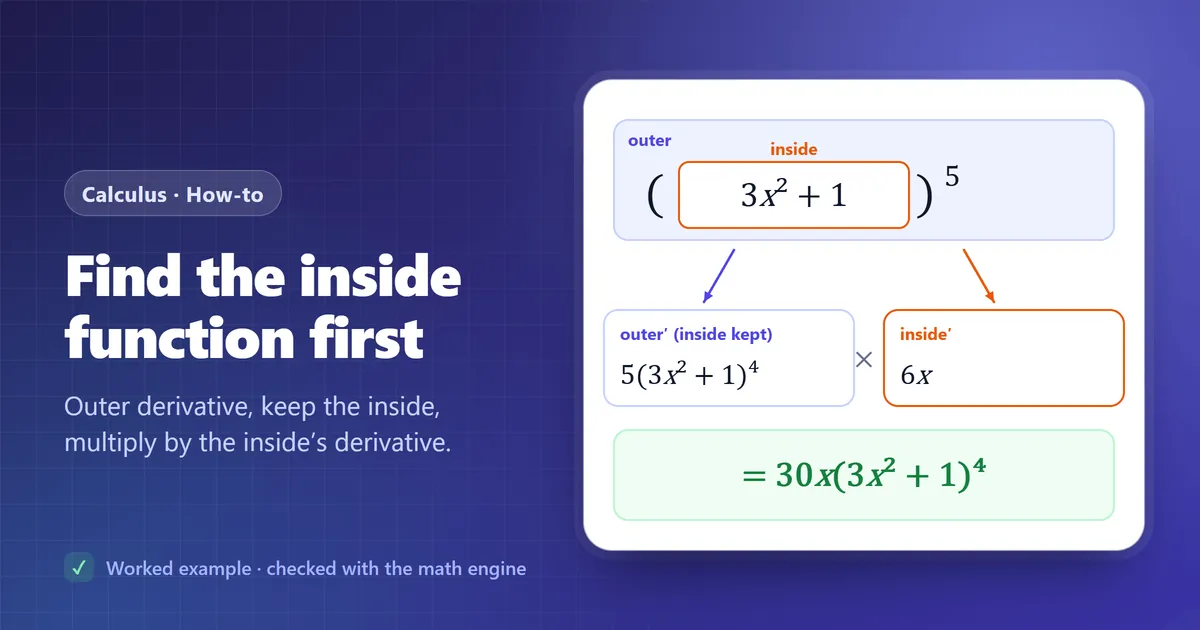
What the chain rule says
If a function is built by putting one function inside another, , its derivative is the derivative of the outside, evaluated at the inside, times the derivative of the inside:
In words: differentiate the outside, leave the inside alone, then multiply by the derivative of the inside.
How to spot the inside function
Ask: if I had to calculate this for x = 2, what would I do last? That last step is the outside function. Everything you did before it is the inside.
- : you would compute first, then raise it to the 5th. Outside: the 5th power. Inside: .
- : compute 4x, then take the sine. Outside: sine. Inside: 4x.
- : cube first, then cosine. Outside: cosine. Inside: .
If the inside is just x, there is no chain rule — the extra factor would be 1.
Example 1 · A power of a polynomial
Bring down the 5, keep the bracket, then multiply by 6x.
- Differentiate with respect to xThis is the derivative to find.
- Apply the power ruleBring the exponent down front, then lower it by one.
- SimplifyCollect terms for the final answer.
Example 2 · A linear inside
The inside 4x contributes a factor of 4.
- Differentiate with respect to xThis is the derivative to find.
- Apply the chain ruleDifferentiate the outer function, then multiply by the derivative of what is inside.
- Differentiate the outer and inner partsHandle each layer on its own.
- SimplifyCollect terms for the final answer.
Example 3 · Trig of a power
Cosine differentiates to minus sine; the cube contributes .
- Differentiate with respect to xThis is the derivative to find.
- Apply the chain ruleDifferentiate the outer function, then multiply by the derivative of what is inside.
- Differentiate the outer and inner partsHandle each layer on its own.
- SimplifyCollect terms for the final answer.
Chains inside products
In real problems the chain rule turns up inside other rules. In , the product rule splits the work, and one of the pieces needs the chain rule. Work one layer at a time and write each piece down before combining them.
The derivative calculator names each rule as it applies it, which is a good way to check you have not skipped a layer. For AP students, the chain rule is the heart of Unit 3 — see the AP Calculus page.