
Limits calculator

Limit Calculator

Type lim x->a and an expression. The limit calculator tries direct substitution first and, when that gives 0/0, factors, cancels or rationalizes until it can substitute — then confirms the value by evaluating closer and closer to a.

  • Independent answer checks
  • Every step shown
  • Free, no sign-up

What math problem do you want to solve?

Ctrl+V pastes a screenshot · Shift+Enter: new line (one equation per line)

Try

Typed problems our engine solves stay in your browser. Photos, screenshots, PDFs and AI-helped problems are processed by our AI service — privacy.

Limits · worked example✓ Verified
lim⁡x→0x+9−3x\lim_{x \to 0} \frac{\sqrt{x+9} - 3}{x}
Find the limit as x → 0
lim(x→0)x+9−3xlim (x→0) \frac{\sqrt{x+9}-3}{x}
Direct substitution does not work
f(0)=undefined\displaystyle f(0) = \allowbreak \text{undefined}
Approach from both sides
x→0+ and x→0− both give ≈0.1666666667, i.e. 16\displaystyle x → 0⁺ \allowbreak \text{ and } x → 0⁻ \allowbreak \text{ both give } ≈ 0.1666666667,\allowbreak \allowbreak \text{ i.e. } \frac{1}{6}
16\frac{1}{6}Re-checked by a second engine
Limits · worked example✓ Verified
lim⁡x→2x3−8x−2\lim_{x \to 2} \frac{x^{3} - 8}{x - 2}
Find the limit as x → 2
lim(x→2)x3−8x−2lim (x→2) \frac{x^{3}-8}{x-2}
Direct substitution gives 0/0
f(2)=00f(2) = \frac{0}{0}
Factor the numerator and denominator
x3−8x−2=(x−2)(x2+2x+4)x−2\frac{x^{3}-8}{x-2} = \frac{(x - 2)(x^{2} + 2x + 4)}{x - 2}
1212Re-checked by a second engine
Limits · worked example✓ Verified
lim⁡x→4x−4x2−16\lim_{x \to 4} \frac{x - 4}{x^{2} - 16}
Find the limit as x → 4
lim(x→4)x−4x2−16lim (x→4) \frac{x-4}{x^{2}-16}
Direct substitution gives 0/0
f(4)=00f(4) = \frac{0}{0}
Factor the numerator and denominator
x−4x2−16=x−4(x−4)(x+4)\frac{x-4}{x^{2}-16} = \frac{x - 4}{(x - 4)(x + 4)}
18\frac{1}{8}Re-checked by a second engine

1 / 3

Quick examples

Study guide

How to solve limits

A limit asks: what value does the function approach as x gets close to a — even if the function is undefined exactly at a? Direct substitution works whenever the function is continuous there.

The classic trap is the 0/0 form. In (x²−4)/(x−2) at x=2, both top and bottom are zero — but factoring the top as (x−2)(x+2) lets you cancel the (x−2) and get x+2, whose limit is 4.

Always try simplifying first for indeterminate forms: factor, cancel common factors, or rationalize roots. Only after simplifying should you substitute the approach value.

Memorize the two famous trig limits: sin(x)/x → 1 as x→0, and (1−cos(x))/x → 0 as x→0. They appear constantly in AP Calculus.

If direct substitution gives a non-zero number over zero, the limit is infinite (or does not exist) — the function blows up near that point. The solver checks both sides before answering.

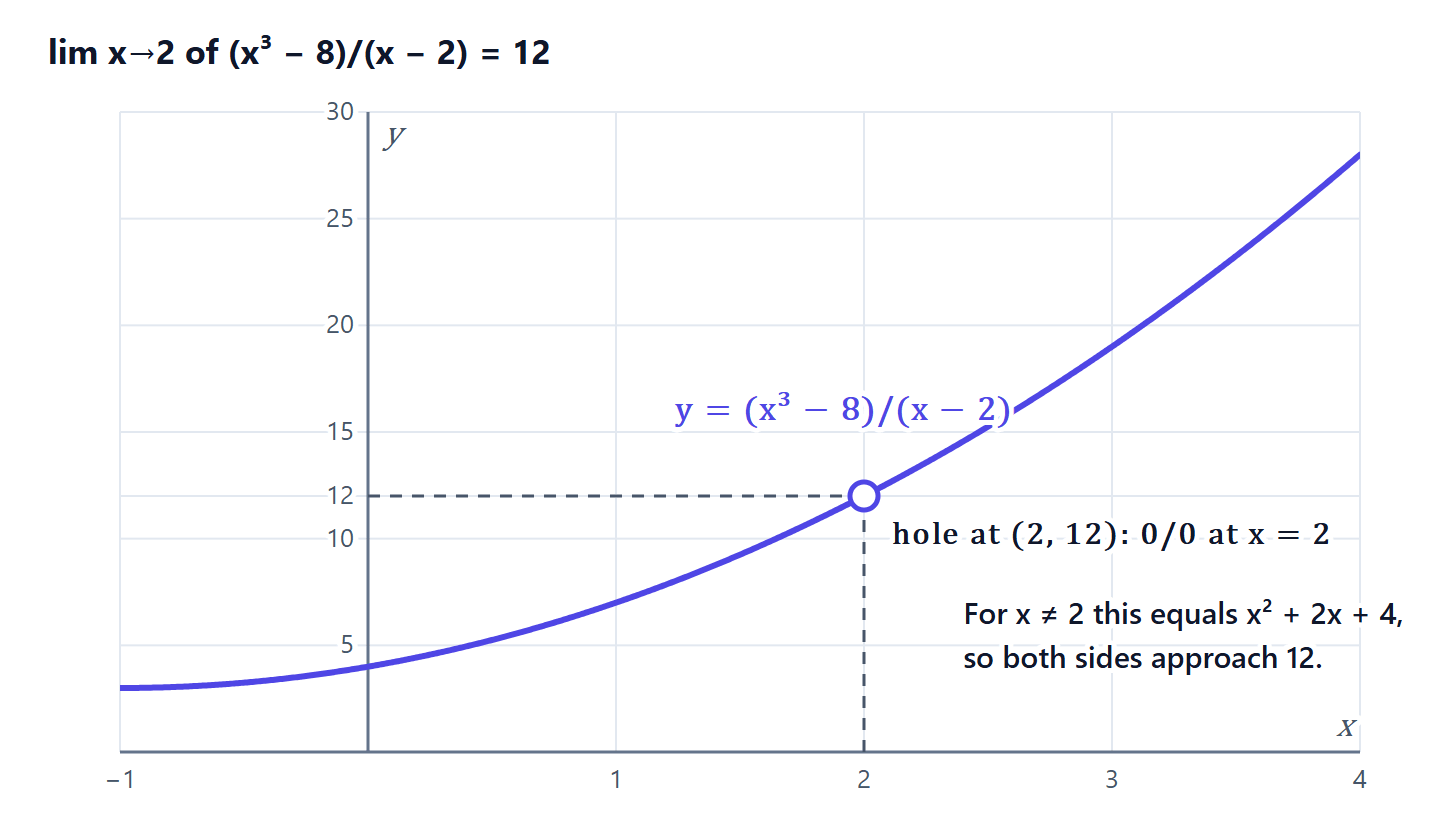
Graph of y = (x³ − 8)/(x − 2), which matches the parabola x² + 2x + 4 except for an open circle, a hole, at (2, 12); dashed guides show the curve heading to height 12 as x approaches 2.
At x = 2 the fraction is 0/0 and undefined, but the curve heads to 12 from both sides — the limit is 12. Cancelling the factor x − 2 leaves x² + 2x + 4.

Checking the result

How this result is checked

Supported limit checks in the math engine examine values near the approach point, using the requested side when applicable. Numerical agreement is not a general proof of a limit.

A routine for any limit

How the limit calculator handles 0/0

  1. Substitute directly. If you get a real number, that is the limit (for continuous functions). Many limits end here.
  2. Got 0/0? That is an indeterminate form — a signal to simplify. Factor and cancel (the factoring calculator shows the patterns), or multiply by a conjugate if there is a square root.
  3. Got a number over 0? The function blows up near that point; check the sign from each side. The limit is ±∞\pm\infty or does not exist.
  4. Heading to infinity? Divide every term by the highest power of x in the denominator.

The point of a limit is the value the function approaches, not its value at a. That is why x3−8x−2\frac{x^3 - 8}{x - 2} can have a limit at 2 even though it is undefined there. Limits and continuity open the AP Calculus course, so this routine comes up from the first unit.

Rationalizing

Limits with square roots

For lim⁡x→0x+9−3x\lim_{x \to 0}\frac{\sqrt{x + 9} - 3}{x}, substitution gives 0/0 and there is nothing to factor. Multiply top and bottom by the conjugate x+9+3\sqrt{x + 9} + 3:

(x+9−3)(x+9+3)x(x+9+3)=xx(x+9+3)=1x+9+3\frac{(\sqrt{x+9} - 3)(\sqrt{x+9} + 3)}{x(\sqrt{x+9} + 3)} = \frac{x}{x(\sqrt{x+9} + 3)} = \frac{1}{\sqrt{x+9} + 3}

Now substitution works: 13+3=16\frac{1}{3 + 3} = \frac{1}{6}.

A limit that comes from a longer calculus question can be entered in full in the AI math solver, which works through the whole question and reports whether the result was checked.

Reference

Limits to recognize on sight

Sine limit

lim⁡x→0sin⁡xx=1\lim_{x \to 0}\frac{\sin x}{x} = 1

With x in radians.

Cosine limit

lim⁡x→01−cos⁡xx=0\lim_{x \to 0}\frac{1 - \cos x}{x} = 0

Difference of cubes

x3−a3x−a=x2+ax+a2\frac{x^3 - a^3}{x - a} = x^2 + ax + a^2

Cancels the 0/0 at x = a.

Rational at infinity

lim⁡x→∞axn+…bxn+…=ab\lim_{x \to \infty}\frac{a x^n + \dots}{b x^n + \dots} = \frac{a}{b}

Equal degrees: ratio of leading coefficients. Higher degree on the bottom: 0.

Worked examples

Limits, worked step by step

Each solution below is the solver’s own working, checked before it was published. Press “Solve it live” to open it in the calculator above.

Example 1 · Factor a difference of cubes

lim⁡x→2x3−8x−2\lim_{x \to 2} \frac{x^{3} - 8}{x - 2}

0/0 at x = 2. Factor the top and the troublesome x − 2 cancels.

1212
✓ Verified

Independent check

x→2+:f(2.0001)=12.00060001x \to 2^+:\quad f(2.0001) = 12.00060001
x→2−:f(1.9999)=11.99940001x \to 2^-:\quad f(1.9999) = 11.99940001
  1. Find the limit as x → 2
    lim(x→2)x3−8x−2lim (x→2) \frac{x^{3}-8}{x-2}
    This is the limit to evaluate.
  2. Direct substitution gives 0/0
    f(2)=00f(2) = \frac{0}{0}
    0/0 is indeterminate: it does not tell us the limit yet, so the expression needs work first.
  3. Factor the numerator and denominator
    x3−8x−2=(x−2)(x2+2x+4)x−2\frac{x^{3}-8}{x-2} = \frac{(x - 2)(x^{2} + 2x + 4)}{x - 2}
    Both are 0 at x = 2, so both contain the factor x - 2.
  4. Cancel the common factor x - 2
    x2+2x+4x^{2} + 2x + 4
    This equals the original for every x ≠ 2 — and a limit never uses the value at x = 2 itself.
  5. Substitute x = 2
    1212
    The cancelled form is defined at the point, so substitution now works.

Example 2 · Factor the bottom

lim⁡x→4x−4x2−16\lim_{x \to 4} \frac{x - 4}{x^{2} - 16}

This time the difference of squares is in the denominator.

18\frac{1}{8}
✓ Verified

Independent check

x→4+:f(4.0001)=0.1249984375x \to 4^+:\quad f(4.0001) = 0.1249984375
x→4−:f(3.9999)=0.1250015625x \to 4^-:\quad f(3.9999) = 0.1250015625
  1. Find the limit as x → 4
    lim(x→4)x−4x2−16lim (x→4) \frac{x-4}{x^{2}-16}
    This is the limit to evaluate.
  2. Direct substitution gives 0/0
    f(4)=00f(4) = \frac{0}{0}
    0/0 is indeterminate: it does not tell us the limit yet, so the expression needs work first.
  3. Factor the numerator and denominator
    x−4x2−16=x−4(x−4)(x+4)\frac{x-4}{x^{2}-16} = \frac{x - 4}{(x - 4)(x + 4)}
    Both are 0 at x = 4, so both contain the factor x - 4.
  4. Cancel the common factor x - 4
    1x+4\frac{1}{x + 4}
    This equals the original for every x ≠ 4 — and a limit never uses the value at x = 4 itself.
  5. Substitute x = 4
    18\frac{1}{8}
    The cancelled form is defined at the point, so substitution now works.

Example 3 · Multiply by the conjugate

lim⁡x→0x+9−3x\lim_{x \to 0} \frac{\sqrt{x+9} - 3}{x}

A square root in the numerator: rationalize to remove the 0/0.

16\frac{1}{6}
✓ Verified

Independent check

x→0+:f(0.0001)=0.1666662037x \to 0^+:\quad f(0.0001) = 0.1666662037
x→0−:f(−0.0001)=0.1666671296x \to 0^-:\quad f(-0.0001) = 0.1666671296
  1. Find the limit as x → 0
    lim(x→0)x+9−3xlim (x→0) \frac{\sqrt{x+9}-3}{x}
    This is the limit to evaluate.
  2. Direct substitution does not work
    f(0)=undefined\displaystyle f(0) = \allowbreak \text{undefined}
    Plugging the point straight in fails, so the expression needs work first.
  3. Approach from both sides
    x→0+ and x→0− both give ≈0.1666666667, i.e. 16\displaystyle x → 0⁺ \allowbreak \text{ and } x → 0⁻ \allowbreak \text{ both give } ≈ 0.1666666667,\allowbreak \allowbreak \text{ i.e. } \frac{1}{6}
    When both sides close in on the same number, that number is the limit.

Example 4 · A standard trig limit

lim⁡x→01−cos⁡(x)x\lim_{x \to 0} \frac{1 - \cos(x)}{x}

One of the two trig limits every calculus course builds on.

00
✓ Verified

Independent check

x→0+:f(0.0001)=0.0000499999997x \to 0^+:\quad f(0.0001) = 0.0000499999997
x→0−:f(−0.0001)=−0.0000499999997x \to 0^-:\quad f(-0.0001) = -0.0000499999997
  1. Find the limit as x → 0
    lim(x→0)1−cos⁡(x)xlim (x→0) \frac{1-\cos(x)}{x}
    This is the limit to evaluate.
  2. Direct substitution does not work
    f(0)=undefined\displaystyle f(0) = \allowbreak \text{undefined}
    Plugging the point straight in fails, so the expression needs work first.
  3. Approach from both sides
    x→0+ and x→0− both give ≈0\displaystyle x → 0⁺ \allowbreak \text{ and } x → 0⁻ \allowbreak \text{ both give } ≈ 0
    When both sides close in on the same number, that number is the limit.

Avoid these

Common limits mistakes

  • Writing 0/0 as the answer

    0/0 is not a value. It means "simplify and try again".

  • Saying 0/0 = 1

    Indeterminate forms can be any number. x3−8x−2\frac{x^3 - 8}{x - 2} tends to 12, not 1.

  • Cancelling before factoring

    In x2−16x−4\frac{x^2 - 16}{x - 4} you cannot cancel the x’s. Factor first: (x−4)(x+4)(x - 4)(x + 4).

  • Degrees instead of radians

    lim⁡x→0sin⁡xx=1\lim_{x \to 0}\frac{\sin x}{x} = 1 only in radians — the unit the trigonometry calculator also uses for plain numbers.

  • Ignoring one-sided behavior

    For a number over zero, check the left and right sides. If they disagree, the two-sided limit does not exist.

  • Dropping the "lim"

    Keep writing lim⁡x→a\lim_{x \to a} on every line until you substitute; teachers mark the notation.

FAQ

Limits calculator FAQ

How do you solve a 0/0 limit?

Factor and cancel first. For (x²−4)/(x−2) at x=2: factor the top to (x−2)(x+2), cancel (x−2), then substitute: 2+2=4.

What is the limit of sin(x)/x as x approaches 0?

1. This is a standard result worth memorizing — it appears throughout AP Calculus.

Can a limit exist where the function is undefined?

Yes — that is the whole point of limits. (x²−4)/(x−2) is undefined at x=2, but its limit there is 4.

What if I get a number divided by zero?

Then the function grows without bound near that point — the (two-sided) limit does not exist as a finite number. Check the left and right behavior separately.

How is a limit verified?

The function is evaluated at points closer and closer to a (from both sides) and the values must settle on the answer. For limits at infinity, ever-larger values of x are used.

Can it do one-sided limits?

Yes — write lim x->0+ for the right-hand limit or lim x->0- for the left-hand limit, or type it in words: "limit as x approaches 0 from the right of …". Only the marked side is probed and verified; if that side has no finite limit, the solver says so instead of marking a value ✓ Verified.

How do I type infinity?

Write x->infinity, for example lim x->infinity (3x^2+1)/(x^2-5).

Your own limits problem

Type lim, the approach and your expression, and the limit calculator shows why the 0/0 disappears — with the value confirmed from both sides.