
Trigonometry calculator

Trigonometry Calculator

Evaluate sine, cosine and tangent at the standard angles and get exact values — ½, √3/2, −1 — instead of long decimals. The trigonometry calculator shows the reference angle and the sign rule it used to get there.

  • Independent answer checks
  • Every step shown
  • Free, no sign-up

What math problem do you want to solve?

Ctrl+V pastes a screenshot · Shift+Enter: new line (one equation per line)

Try

Typed problems our engine solves stay in your browser. Photos, screenshots, PDFs and AI-helped problems are processed by our AI service — privacy.

Trigonometry · worked example✓ Verified
cos⁡(2π3)\cos(\frac{2\pi}{3})
Start with the expression
cos⁡(2π3)\cos(\frac{2\pi}{3})
Combine like terms
−12-\frac{1}{2}
−12-\frac{1}{2}Re-checked by a second engine
Trigonometry · worked example✓ Verified
tan⁡(π3)\tan(\frac{\pi}{3})
Combine like terms
3123^{\frac{1}{2}}
Write in simplest surd form
3\sqrt{3}
3\sqrt{3}Re-checked by a second engine
Trigonometry · worked example✓ Verified
sin⁡(5π6)\sin(\frac{5\pi}{6})
Start with the expression
sin⁡(5π6)\sin(\frac{5\pi}{6})
Combine like terms
12\frac{1}{2}
12\frac{1}{2}Re-checked by a second engine

1 / 3

Quick examples

Study guide

How to solve trigonometry

Trigonometry relates angles to ratios in right triangles: sine is opposite/hypotenuse, cosine is adjacent/hypotenuse, and tangent is opposite/adjacent (or sin/cos).

Learn the standard angles and the solver returns exact values, not decimals: sin(π/6) = 1/2, cos(π/3) = 1/2, and sin(π/4) = cos(π/4) = √2/2.

Type angles with pi for exactness: sin(pi/6), cos(pi/3), tan(pi/4). The engine recognizes π and simplifies to exact fractions and roots where they exist.

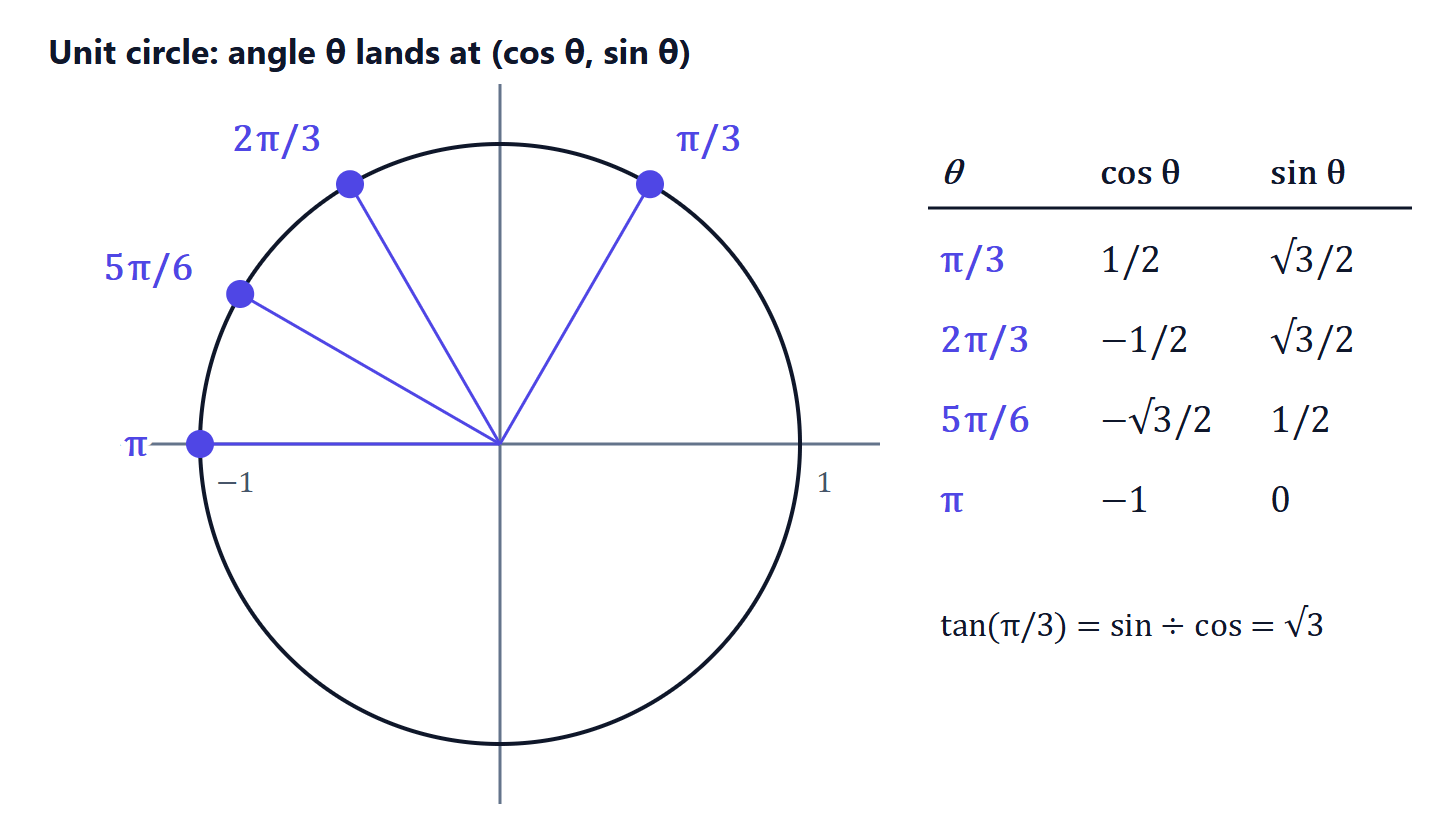
The unit circle ties it together: cos(θ) is the x-coordinate and sin(θ) is the y-coordinate of the point at angle θ. That is why cos(0) = 1 and sin(π/2) = 1.

Remember the Pythagorean identity sin²θ + cos²θ = 1 — it is the fastest way to find a missing trig value and the starting point for most trig proofs.

Unit circle with four marked angles and their points: π/3 at (1/2, √3/2), 2π/3 at (−1/2, √3/2), 5π/6 at (−√3/2, 1/2) and π at (−1, 0); each point is (cos θ, sin θ).
On the unit circle each angle θ lands at (cos θ, sin θ). The four angles from the worked examples: π/3, 2π/3, 5π/6 and π.

Checking the result

How this result is checked

Supported trigonometric answers receive operation-specific checks in the math engine. Angle notation and domains matter, and some degree-based equation cases remain unsupported or unreliable.

Exact values by method

Finding an exact value in any quadrant

You only need to memorize the values for 0, π/6, π/4, π/3 and π/2. Every other standard angle is one of those in disguise:

  1. Find the reference angle — the acute angle between the terminal side and the x-axis. For 2π3\frac{2\pi}{3} it is π−2π3=π3\pi - \frac{2\pi}{3} = \frac{\pi}{3}.
  2. Look up the value of the function at the reference angle: cos⁡π3=12\cos\frac{\pi}{3} = \frac{1}{2}.
  3. Attach the sign for the quadrant. 2π3\frac{2\pi}{3} is in quadrant II, where cosine is negative, so cos⁡2π3=−12\cos\frac{2\pi}{3} = -\frac{1}{2}.

The memory aid "All Students Take Calculus" gives the positive functions in quadrants I–IV: All, Sine, Tangent, Cosine.

Radians and degrees

Typing angles into the trigonometry calculator

Type π as pi: cos(2pi/3), tan(pi/3). Plain numbers are read as radians; for degrees add the ° sign or the word: cos(120°), tan(45 degrees). To convert by hand, multiply degrees by π180\frac{\pi}{180}: 120° is 2π3\frac{2\pi}{3}.

The trigonometry calculator is built for one job: a value at an angle. To solve a trig equation — every angle where sin⁡x=12\sin x = \frac{1}{2}, say — prove an identity, or work from a photo or a word problem, use the AI trigonometry solver, which finds every solution in a period.

Questions that mix trigonometry with algebra or geometry can also go straight into the AI math solver, which reads the whole problem first and shows whether its answer was checked.

Reference

The unit-circle values to memorize

Read across: sine, cosine and tangent at each first-quadrant angle.

0

sin⁡0=0, cos⁡0=1, tan⁡0=0\sin 0 = 0,\ \cos 0 = 1,\ \tan 0 = 0

π/6 (30°)

12, 32, 33\tfrac{1}{2},\ \tfrac{\sqrt{3}}{2},\ \tfrac{\sqrt{3}}{3}

π/4 (45°)

22, 22, 1\tfrac{\sqrt{2}}{2},\ \tfrac{\sqrt{2}}{2},\ 1

π/3 (60°)

32, 12, 3\tfrac{\sqrt{3}}{2},\ \tfrac{1}{2},\ \sqrt{3}

π/2 (90°)

1, 0, undefined1,\ 0,\ \text{undefined}

Pythagorean identity

sin⁡2θ+cos⁡2θ=1\sin^2\theta + \cos^2\theta = 1

Holds for every angle — a quick check on any pair of values.

Worked examples

Trigonometry, worked step by step

Each solution below is the solver’s own working, checked before it was published. Press “Solve it live” to open it in the calculator above.

Example 1 · Quadrant II cosine

cos⁡(2π3)\cos(\frac{2\pi}{3})

Reference angle π/3; cosine is negative in quadrant II.

−12-\frac{1}{2}
✓ Verified

Independent check

cos⁡(2⋅π3)=−12\cos\left(\frac{2\cdot \pi}{3}\right) = \frac{-1}{2}
  1. Start with the expression
    cos⁡(2π3)\cos(\frac{2\pi}{3})
    This is the expression to simplify.
  2. Combine like terms
    −12-\frac{1}{2}
    Add and subtract matching terms and cancel where possible.

Example 2 · Tangent at 60°

tan⁡(π3)\tan(\frac{\pi}{3})

Tangent is sine over cosine: 3/21/2\frac{\sqrt{3}/2}{1/2}.

3\sqrt{3}
✓ Verified

Independent check

tan⁡(π3)=3\tan\left(\frac{\pi}{3}\right) = \sqrt{3}
  1. Combine like terms
    3123^{\frac{1}{2}}
    Add and subtract matching terms and cancel where possible.
  2. Write in simplest surd form
    3\sqrt{3}
    Whole-number part first, then the surd terms.

Example 3 · Quadrant II sine

sin⁡(5π6)\sin(\frac{5\pi}{6})

Reference angle π/6; sine stays positive in quadrant II.

12\frac{1}{2}
✓ Verified

Independent check

sin⁡(5⋅π6)=12\sin\left(\frac{5\cdot \pi}{6}\right) = \frac{1}{2}
  1. Start with the expression
    sin⁡(5π6)\sin(\frac{5\pi}{6})
    This is the expression to simplify.
  2. Combine like terms
    12\frac{1}{2}
    Add and subtract matching terms and cancel where possible.

Example 4 · A point on an axis

cos⁡(π)\cos(\pi)

At π the terminal side points along the negative x-axis.

−1-1
✓ Verified

Independent check

cos⁡(π)=−1\cos\left(\pi\right) = -1
  1. Combine like terms
    −1-1
    Add and subtract matching terms and cancel where possible.

Avoid these

Common trigonometry mistakes

  • Degree mode, radian problem

    On a handheld calculator, sin⁡(π/6)\sin(\pi/6) in degree mode is about 0.009, not 0.5. Check the mode first.

  • Wrong sign for the quadrant

    The reference-angle value is always positive; the quadrant decides the sign.

  • Mixing up sin and cos at 30° and 60°

    sin⁡30°=12\sin 30° = \tfrac{1}{2} and cos⁡60°=12\cos 60° = \tfrac{1}{2}. Draw the 30-60-90 triangle if unsure.

  • Tangent at π/2

    tan⁡π2\tan\frac{\pi}{2} is undefined (cosine is zero), not infinity or zero.

  • Not rationalizing

    13\frac{1}{\sqrt{3}} is usually written 33\frac{\sqrt{3}}{3}.

  • Writing sin²x as sin(x²)

    sin⁡2x\sin^2 x means (sin⁡x)2(\sin x)^2. Type it as sin(x)^2 to be unambiguous.

FAQ

Trigonometry calculator FAQ

How do I type π in the solver?

Just type pi. For example sin(pi/6) evaluates to the exact value 1/2.

What are the exact values I should memorize?

sin and cos of 0, π/6, π/4, π/3 and π/2: the pattern 0, 1/2, √2/2, √3/2, 1 covers sine from 0 to π/2 (cosine runs it in reverse).

What is the relationship between sin, cos and tan?

tan(θ) = sin(θ)/cos(θ). So tan(π/4) = 1, since sin and cos of π/4 are equal.

Why does the solver give fractions instead of decimals?

Exact values like 1/2 are mathematically precise, while decimals like 0.5 are rounded. Teachers and tests expect the exact form.

Can it work in degrees?

Yes. Add the ° sign or the word: cos(120°), tan(45 degrees). Plain numbers are read as radians, so cos(120°) and cos(2pi/3) both give −1/2.

Can it evaluate inverse trig functions?

For equations such as sin⁡x=32\sin x = \frac{\sqrt{3}}{2}, use the trigonometry solver: it returns every angle in one period, which is what inverse trig on a calculator only partly gives you.

Your own trigonometry problem

Type the angle in radians or degrees — like cos(2pi/3) or cos(120°) — and see the reference angle and the sign rule that give the exact value.