
Logarithms calculator

Logarithm Calculator for Solving Log Expressions

A logarithm calculator evaluates supported logarithms and equations using their bases and arguments. The displayed working connects logarithmic and exponential forms.

  • Independent answer checks
  • Every step shown
  • Free, no sign-up

What math problem do you want to solve?

Ctrl+V pastes a screenshot · Shift+Enter: new line (one equation per line)

Try

Typed problems our engine solves stay in your browser. Photos, screenshots, PDFs and AI-helped problems are processed by our AI service — privacy.

For real logarithms, the argument must be positive and the base must be positive and different from one. Check proposed solutions against those restrictions.

Logarithms · worked example✓ Verified
log⁡3(x)+log⁡3(x−8)=2\log_{3}(x) + \log_{3}(x - 8) = 2
Identify the base
b=3b = 3
Combine into a single logarithm
log⁡3(x⋅(x−8))=2\log_{3}(x \cdot (x - 8)) = 2
Write in exponential form
x⋅(x−8)=32x \cdot (x - 8) = 3^{2}
x=9x = 9Re-checked by a second engine
Logarithms · worked example✓ Verified
log⁡(x)−log⁡(2)=1\log(x) - \log(2) = 1
Identify the base
b=10b = 10
Combine into a single logarithm
log⁡10(x⋅12)=1\log_{10}(x \cdot \frac{1}{2}) = 1
Write in exponential form
x⋅12=101x \cdot \frac{1}{2} = 10^{1}
x=20x = 20Re-checked by a second engine
Logarithms · worked example✓ Verified
log⁡4(x)=3\log_{4}(x) = 3
Identify the base
b=4b = 4
Write in exponential form
x=43x = 4^{3}
x=64x = 64Re-checked by a second engine

1 / 3

Quick examples

Study guide

How to solve logarithms

A logarithm answers the question: "to what power must I raise the base to get this number?" So log₁₀(1000) = 3 because 10³ = 1000. Thinking of logs as exponents makes everything click.

In the solver, type logarithms as log(value, base). log(1000,10) means base-10 log of 1000, and log(32,2) means base-2 log of 32, which is 5 because 2⁵ = 32.

The natural log ln(x) is log base e (≈ 2.718). Because e² means "e raised to 2", ln(e²) = 2 directly — the log and the exponential undo each other.

Three log laws do most of the work: log(ab) = log(a) + log(b), log(a/b) = log(a) − log(b), and log(aⁿ) = n·log(a). They turn hard logs into easy arithmetic.

The change-of-base formula, log_b(a) = ln(a)/ln(b), lets you evaluate any log with the natural log. It is also how calculators compute logs behind the scenes.

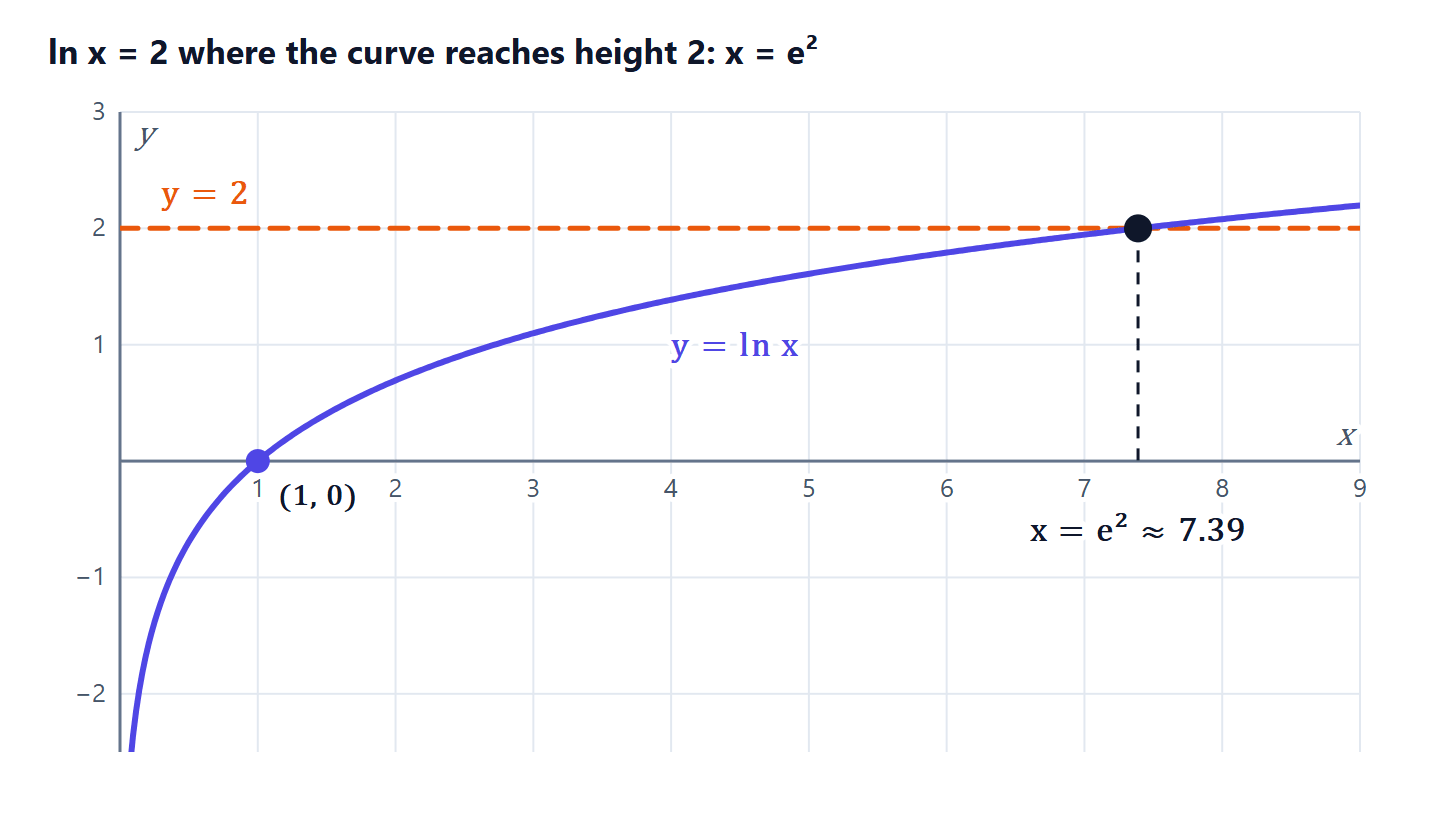
Graph of y = ln x meeting the horizontal line y = 2 at x = e², about 7.39; the curve passes through (1, 0) and rises slowly to the right.
Solving ln x = 2 graphically: the curve y = ln x reaches height 2 at x = e² ≈ 7.39. Rewriting the log as an exponential, x = e², gives the same answer exactly.

Checking the result

How this result is checked

Substitution must respect the original logarithm domains. The math engine checks supported answers without treating a nonpositive logarithm argument as valid.

What a log is

A logarithm is an exponent

log⁡ba\log_b a asks one question: what power of b gives a? Since 25=322^5 = 32, log⁡232=5\log_2 32 = 5. Every log problem can be turned into an exponent problem with this one rule:

log⁡ba=c  ⟺  bc=a\log_b a = c \iff b^c = a

Two bases are so common they get their own notation: log⁡x\log x usually means base 10, and ln⁡x\ln x means base e≈2.718e \approx 2.718, the natural logarithm.

In the calculator, type log_3(x) or log(x, 3) for base 3, log(x) for base 10 and ln(x) for the natural log.

Solving log equations

How the logarithm calculator solves log equations

  1. Combine the logs on each side into a single log with the product or quotient rule.
  2. Convert to exponential form: log⁡3(… )=2\log_3(\dots) = 2 means the inside equals 323^2.
  3. Solve the equation that is left — often linear or quadratic.
  4. Check the domain. Every log in the original equation needs a positive argument. Reject any root that breaks this, even if the algebra produced it. It is the same positivity rule used in how to find the domain of a function.

Step 4 is where marks are lost. In log⁡3x+log⁡3(x−8)=2\log_3 x + \log_3(x - 8) = 2, the quadratic gives x=9x = 9 or x=−1x = -1, but log⁡3(−1)\log_3(-1) does not exist. Only x=9x = 9 is a solution.

Log equations also turn up inside longer problems, such as growth and decay questions. The AI math solver accepts the whole question and shows whether its answer passed an independent check.

Reference

The log laws

The log-rules deck of the math flashcards drills these until they are automatic.

Product rule

log⁡b(xy)=log⁡bx+log⁡by\log_b(xy) = \log_b x + \log_b y

Quotient rule

log⁡bxy=log⁡bx−log⁡by\log_b\frac{x}{y} = \log_b x - \log_b y

Power rule

log⁡b(xn)=nlog⁡bx\log_b(x^n) = n\log_b x

Change of base

log⁡bx=ln⁡xln⁡b\log_b x = \frac{\ln x}{\ln b}

How calculators find logs of any base.

Inverse pair

log⁡b(bx)=x,blog⁡bx=x\log_b(b^x) = x,\quad b^{\log_b x} = x

Special values

log⁡b1=0,log⁡bb=1\log_b 1 = 0,\quad \log_b b = 1

Worked examples

Logarithms, worked step by step

Each solution below is the solver’s own working, checked before it was published. Press “Solve it live” to open it in the calculator above.

Example 1 · Combine, then reject a root

log⁡3(x)+log⁡3(x−8)=2\log_{3}(x) + \log_{3}(x - 8) = 2

The product rule makes one log; the resulting quadratic has a root that must be thrown out.

x=9x = 9
✓ Verified

Independent check

x=9:log⁡3(9)+log⁡3(1)=2, and the equation needs 2 — it holds.x = 9:\quad \log_{3}\left(9\right) + \log_{3}\left(1\right) = 2\text{, and the equation needs } 2\text{ — it holds.}
x=−1:a logarithm argument would be ≤0, so it is outside the domain.x = -1:\quad \text{a logarithm argument would be } \le 0\text{, so it is outside the domain.}
  1. Identify the base
    b=3b = 3
    log_3 means base 3.
  2. Combine into a single logarithm
    log⁡3(x⋅(x−8))=2\log_{3}(x \cdot (x - 8)) = 2
    Product rule: log(u) + log(v) = log(uv).
  3. Write in exponential form
    x⋅(x−8)=32x \cdot (x - 8) = 3^{2}
    Definition of logarithm: log_b(A) = K means A = b^K.
  4. Write in standard form
    x2−8x−9=0x^{2} - 8x - 9 = 0
    Quadratics are easiest to solve as ax^2 + bx + c = 0.
  5. Identify a, b and c
    a=1,b=−8,c=−9\displaystyle a = 1,\allowbreak b = -8,\allowbreak c = -9
    The coefficients decide which method works best.
  6. Factor the quadratic
    (x−9)(x+1)=0(x - 9)(x + 1) = 0
    The discriminant is a perfect square, so the quadratic splits into two linear factors.
  7. Set each factor to zero
    x=9,x=−1\displaystyle x = 9,\allowbreak x = -1
    A product is zero exactly when one of its factors is zero.
  8. Reject extraneous candidates
    x = -1 rejected
    A logarithm is only defined for positive arguments — those values would break the domain.

Example 2 · Straight to exponential form

log⁡4(x)=3\log_{4}(x) = 3

Base 4 to the power 3 is the inside.

x=64x = 64
✓ Verified

Independent check

x=64:log⁡4(64)=3, and the equation needs 3 — it holds.x = 64:\quad \log_{4}\left(64\right) = 3\text{, and the equation needs } 3\text{ — it holds.}
  1. Identify the base
    b=4b = 4
    log_4 means base 4.
  2. Write in exponential form
    x=43x = 4^{3}
    Definition of logarithm: log_b(A) = K means A = b^K.

Example 3 · The natural log

ln⁡(x)=2\ln(x) = 2

ln has base e, so the answer is a power of e — kept exact.

x=e2x = e^{2}
✓ Verified

Independent check

x=e2:ln⁡(7.389056)=2, and the equation needs 2 — it holds.x = e^2:\quad \ln\left(7.389056\right) = 2\text{, and the equation needs } 2\text{ — it holds.}
  1. Identify the base
    b=eb = e
    ln means the natural logarithm, base e.
  2. Write in exponential form
    x=e2x = e^{2}
    Definition of logarithm: log_b(A) = K means A = b^K.

Example 4 · The quotient rule

log⁡(x)−log⁡(2)=1\log(x) - \log(2) = 1

Two base-10 logs subtracted become one log of a quotient.

x=20x = 20
✓ Verified

Independent check

x=20:log⁡10(20)−log⁡10(2)=1, and the equation needs 1 — it holds.x = 20:\quad \log_{10}\left(20\right) - \log_{10}\left(2\right) = 1\text{, and the equation needs } 1\text{ — it holds.}
  1. Identify the base
    b=10b = 10
    log without a written base means base 10.
  2. Combine into a single logarithm
    log⁡10(x⋅12)=1\log_{10}(x \cdot \frac{1}{2}) = 1
    Quotient rule: log(u) - log(v) = log(u/v).
  3. Write in exponential form
    x⋅12=101x \cdot \frac{1}{2} = 10^{1}
    Definition of logarithm: log_b(A) = K means A = b^K.
  4. Multiply both sides by 2
    x=20x = 20
    This clears the fractions.

Avoid these

Common logarithms mistakes

  • Splitting the log of a sum

    log⁡(x+y)\log(x + y) is not log⁡x+log⁡y\log x + \log y. The product rule needs a product.

  • Keeping an impossible root

    A root that makes any original log argument zero or negative must be rejected.

  • Mixing up the base

    log⁡28=3\log_2 8 = 3 because 23=82^3 = 8 — the base is the number raised to a power.

  • Dividing logs to cancel

    log⁡8log⁡2\frac{\log 8}{\log 2} is log⁡28=3\log_2 8 = 3, not log⁡4\log 4.

  • Power rule backwards

    2log⁡x=log⁡x22\log x = \log x^2, not (log⁡x)2(\log x)^2.

  • log vs ln

    On most calculators and in most US textbooks, "log" is base 10 and "ln" is base e.

FAQ

Logarithms calculator FAQ

How do I type a logarithm in the solver?

Use log(value, base). For example log(1000,10) evaluates the base-10 log of 1000 and returns 3.

What is the natural logarithm ln?

Logarithm with base e (≈2.718). Because ln undoes the exponential, ln(e²)=2 and ln(1)=0.

What are the log laws?

log(ab)=log(a)+log(b), log(a/b)=log(a)−log(b), and log(aⁿ)=n·log(a). They let you split complicated logs into simple ones.

What is log(1)?

0, in any base — because any base raised to the power 0 equals 1.

Can it solve exponential equations like 3^x = 81?

Yes — exponential equations are solved by taking a log of both sides (or matching bases). These are handled by the full math engine in your browser, with steps; the AI algebra solver covers them alongside logs.

What does log mean without a base?

In this solver, as in most US textbooks, log(x) means base 10. Use ln(x) for base e, and log_b(x) or log(x, b) for any other base.

Why was one of my solutions rejected?

Because substituting it into the original equation puts a zero or negative number inside a logarithm, which is undefined. The algebra can produce such roots; the domain check removes them.

Your own logarithms problem

Type log_b(x) or ln(x) into the logarithm calculator and watch every log law applied — with impossible roots removed and the reason given.