


What the domain of a function means
A function takes an input x and returns an output. The domain is every x for which that output is a real number. A polynomial such as never breaks, so its domain is all real numbers, written .
Other formulas have gaps. Division by zero is undefined, the square root of a negative number is not real, and does not exist. Finding a domain means listing those gaps and nothing more.
The natural domain
Unless a problem says otherwise, the domain is the largest set of real numbers the formula accepts. A word problem can shrink it further — a length cannot be negative — but that is a separate restriction you add on top.
How to find the domain of a function in three checks
- Denominators: set each denominator equal to zero, solve, and exclude those values.
- Even roots: the expression under a square root (or a fourth root) must be at least 0. If the root sits in a denominator, it must be greater than 0.
- Logarithms: the input of every log or ln must be greater than 0.
Each check produces one condition. The domain is where all of the conditions hold at the same time, so the last step is to intersect them: keep only the x-values that pass every test.
Functions built only from polynomials, sine, cosine, exponentials and absolute values pass all three checks automatically. Their domain is every real number, which is why a quick scan for fractions, roots and logs is the first thing to do.
Denominators: remove the values that give zero
For a fraction, solve "denominator = 0" and take those values out. In the denominator factors as , so x cannot be 2 or −2. Every other real number is allowed.
In interval notation that domain is three pieces joined by the union symbol: . Every bracket is round, because the excluded values are never part of the set.
A denominator with no real zeros removes nothing. Since is at least 1 for every x, the domain of is all real numbers.
Example 1 · Two values removed by a denominator
Setting x² − 4 = 0 gives x = −2 and x = 2, and both are excluded. The check evaluates the function at both values and at points on either side of them.
- List what each part needsA denominator cannot be 0.
- Solve where it is 0Those values are removed.
- Keep the values where every part worksThe domain is where all the conditions hold at once, shown again in interval notation.
Square roots: the inside must not be negative
An even root needs an inside that is not negative, so its condition is an inequality rather than an equation. For the condition is . Subtracting 6 gives , and dividing by −2 reverses the sign: .
Look closely at the endpoint. At x = 3 the root is , a perfectly good output, so 3 belongs to the domain and takes a square bracket: .
Only even roots restrict the domain
Odd roots do not restrict x. The cube root is real for every x, because the cube root of a negative number is negative. Only even roots need a condition.
Example 2 · A root condition that flips its sign
The condition 6 − 2x ≥ 0 is solved like any linear inequality, and dividing by −2 reverses the direction.
- List what each part needsA real square root needs an inside that is not negative.
- Solve where it is not negativeFind where the expression is 0, then test the sign on each side.
- Keep the values where every part worksThe domain is where all the conditions hold at once, shown again in interval notation.
Example 3 · A square root in the denominator
Here the inside must be strictly positive: x − 1 = 0 would put a zero in the denominator, so the condition is x − 1 > 0 and the endpoint 1 is left out.
- List what each part needsA square root in a denominator needs a positive inside.
- Solve where it is positiveFind where the expression is 0, then test the sign on each side.
- Keep the values where every part worksThe domain is where all the conditions hold at once, shown again in interval notation.
Logarithms: the input must be positive
A logarithm accepts only positive inputs, and zero is not allowed either. For the condition is . Its boundary points are −3 and 3, and testing one value in each region shows that the inside is positive for and for .
The domain is two separate rays, . A domain written with "or" like this is a compound inequality, and reading it is the same skill taught in how to solve compound inequalities.
Example 4 · A logarithm of a quadratic
The inside must be greater than 0. The quadratic is zero at x = −3 and x = 3, positive outside those values and negative between them.
- List what each part needsA logarithm is defined only for positive inputs.
- Solve where it is positiveFind where the expression is 0, then test the sign on each side.
- Keep the values where every part worksThe domain is where all the conditions hold at once, shown again in interval notation.
When a function has more than one restriction
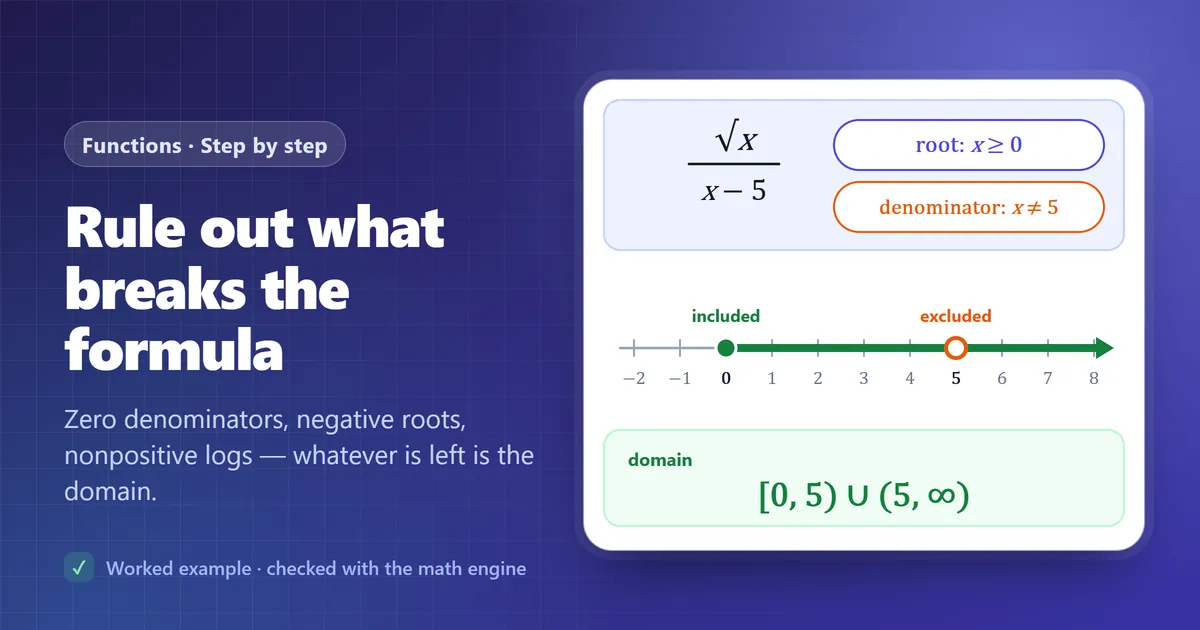
Many functions mix the cases, and this is where knowing how to find the domain of a function one part at a time pays off. In the root needs and the denominator needs . Both must hold, so start from and remove the single value 5.
Written carefully, the domain is : a square bracket at 0, where the root is still defined, and round brackets on both sides of 5.
Example 5 · A root and a denominator together
Two conditions, x ≥ 0 and x − 5 ≠ 0, are intersected. The check tests a point below 0, the values 0 and 5 themselves, and points on either side of 5.
- List what each part needsA real square root needs an inside that is not negative; a denominator cannot be 0.
- Solve where it is not negativeFind where the expression is 0, then test the sign on each side.
- Solve where it is 0Those values are removed.
- Keep the values where every part worksThe domain is where all the conditions hold at once, shown again in interval notation.
x = 0 is in the domain, where the output is 0; x = 5 is not.
Mistakes that change the answer
- Simplifying before you look. simplifies to , but the original is still undefined at x = 1. Read the domain from the function as given — the simplify expression calculator keeps that restriction under its answer for the same reason.
- Using ≥ for a logarithm. needs , so −2 itself is excluded, not included.
- Forgetting to reverse the sign. Dividing by a negative number while solving a root condition flips the inequality, exactly as in .
- Putting a square bracket on infinity. Infinity is never an endpoint you reach, so it always takes a round bracket.
To check your own work, type domain of followed by the function into the AI math solver on the home page or the algebra solver. It lists the condition each part needs before it solves anything, which is the order to follow on paper.
Be clear about its range of cases: it handles denominators, even roots and logarithms built on polynomials up to degree two. A function such as or is declined honestly rather than given a guessed domain.