


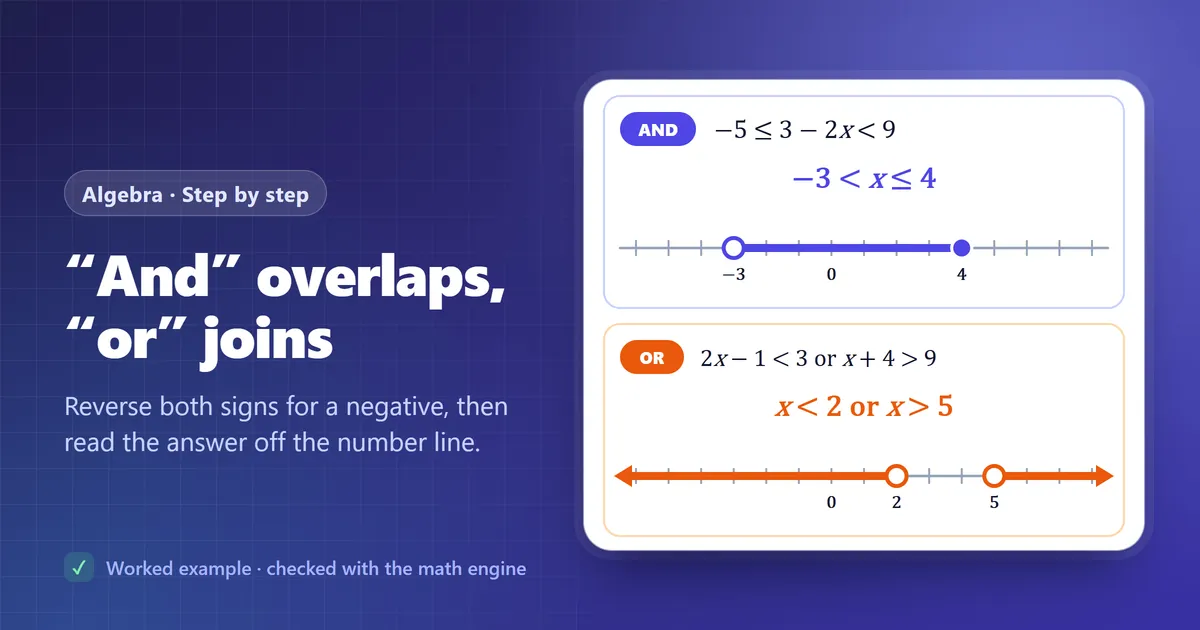
And versus or: what a compound inequality asks
An "and" inequality asks for numbers that pass both tests at once, so its solution is the overlap of two ranges. A chain such as is an "and" inequality written compactly: it means and together.
An "or" inequality accepts any number that passes at least one test. Its solution joins two ranges, and on a number line it usually looks like two rays pointing away from each other.
- "And" means an intersection: one interval such as , or no solution at all when the ranges miss each other.
- "Or" means a union: often two pieces such as , or every real number when the ranges cover the whole line.
How to solve compound inequalities written as a chain
A chain has three parts: a left end, a middle that contains x, and a right end. Rather than splitting it, work on all three parts at once — whatever you add, subtract, multiply or divide in the middle, you do to both ends as well.
- Undo any addition or subtraction in the middle by doing the opposite to all three parts.
- Divide (or multiply) all three parts by the number in front of x.
- If that number is negative, reverse both inequality signs.
- Rewrite the chain from the smaller number to the larger one, then convert it to interval notation.
Example 1 · A chain with a negative coefficient
Subtracting 3 from all three parts gives −8 ≤ −2x < 6. Dividing by −2 reverses both signs, giving 4 ≥ x > −3, which reads −3 < x ≤ 4 from left to right.
- Work on all three parts at onceWhatever is done to the middle is done to both ends, so x stays between them.
- Subtract 3 from all three partsAdding or subtracting the same number keeps every inequality sign as it is.
- Divide all three parts by -2Dividing by a negative number reverses both signs; the chain is then written from the smaller number up.
- Write the answerThe same set in interval notation: a square bracket includes its end, a round one does not.
Each sign travels with its number: the ≤ that stood next to −5 ends up next to 4, so 4 is included and −3 is not.
Fractions inside a chain
A fraction in the middle is cleared the same way, by multiplying all three parts by its denominator. Because the denominator is positive, neither sign changes.
Clearing the fraction first keeps the numbers whole for the rest of the problem. It is the same move that removes denominators from an equation, explained in how to solve equations with fractions.
Example 2 · Clearing a fraction from the middle
Multiplying all three parts by 2 gives 2 < x + 1 < 8, and subtracting 1 from all three leaves 1 < x < 7.
- Work on all three parts at onceWhatever is done to the middle is done to both ends, so x stays between them.
- Multiply all three parts by 2Multiplying by a positive number clears the fraction and keeps both signs.
- Subtract 1 from all three partsAdding or subtracting the same number keeps every inequality sign as it is.
- Write the answerThe same set in interval notation: a square bracket includes its end, a round one does not.
Solving "or" inequalities one part at a time
When two inequalities are joined by "or", solve each one on its own and then combine them. The answer keeps every x that satisfies at least one part, so you join the two solution sets instead of overlapping them.
Absolute-value inequalities are compound inequalities in disguise. says the distance from to 0 is less than 5, which is the chain . The "greater than" version, , becomes the "or" inequality or .
Example 3 · Two rays pointing apart
The first part gives x < 2 and the second gives x > 5. A number such as 3.5 fails both tests, which is why the gap between 2 and 5 is left out.
- Solve the first inequalityCollect x on one side; dividing by a negative number reverses the sign.
- Solve the second inequalityThe same moves give x > 5.
- Keep the values that satisfy either"Or" means at least one must hold, so the answer joins the two ranges.
- Write the answerThe same set in interval notation: a square bracket includes its end, a round one does not.
Example 4 · An absolute value becomes a chain
Rewrite |2x − 1| < 5 as −5 < 2x − 1 < 5. The boundaries come from 2x − 1 = −5 and 2x − 1 = 5, which give x = −2 and x = 3.
- Split into two inequalities|A| < 5 means A is between -5 and 5.
- Boundary: Add 1 to both sidesIsolate the variable term by moving the constant across.
- Divide both sides by 2Dividing by the coefficient of x leaves it alone on the left.
- Boundary: Add 1 to both sidesIsolate the variable term by moving the constant across.
- Divide both sides by 2Dividing by the coefficient of x leaves it alone on the left.
- Write the answerCheck x = 0.5: |0| < 5 is true, and numbers outside -2 to 3 fail.
When the answer is no solution or every number
Two special answers catch students out. An "and" inequality whose ranges never meet has no solution: no number is both above 3 and below 1, so the solution set is empty, written .
An "or" inequality can go the other way. With "x < 4 or x > 1", numbers below 4 pass the first test and numbers from 4 upward pass the second, so every real number qualifies and the solution is .
Example 5 · Two ranges that never overlap
Each part is already solved. Because "and" needs both conditions at once and the two ranges do not meet, the answer is the empty set.
- Solve the first inequalityCollect x on one side; dividing by a negative number reverses the sign.
- Solve the second inequalityThe same moves give x < 1.
- Keep the values that satisfy both"And" means both must hold, and the two ranges do not overlap.
- Write the answerNo solution\qquad \varnothingNo number satisfies every condition.
Example 6 · Two ranges that cover the whole line
Every number is either below 4 or above 1, and most numbers are both, so nothing is left out.
- Solve the first inequalityCollect x on one side; dividing by a negative number reverses the sign.
- Solve the second inequalityThe same moves give x > 1.
- Keep the values that satisfy either"Or" means at least one must hold, so the answer joins the two ranges.
- Write the answerAll real numbers\qquad (-\infty, \infty)The same set in interval notation: a square bracket includes its end, a round one does not.
Writing and checking the answer
Interval notation uses a square bracket when an endpoint is included (≤ or ≥) and a round bracket when it is not (< or >, and always next to infinity). The union symbol ∪ joins the two pieces of an "or" answer. On a number line, an included endpoint is a closed dot and an excluded one is an open dot.
To check an answer, substitute each boundary and one number from every region into the original inequality. If a point you shaded fails, or a point you left out passes, something went wrong — most often a sign that should have been reversed. The solver runs this same test before it shows the ✓ Verified badge.
- Reversing only one sign. Dividing a chain by a negative number reverses both signs, not just the nearer one.
- Treating "or" like "and". Overlapping the two ranges of an "or" problem throws away valid answers.
- Forgetting to combine the halves. Solving the two halves of separately is fine, but the answer is their overlap, .
- Squeezing an "or" answer into one chain. "x < 2 or x > 5" cannot be written as , because no number fits that chain. Keep the two pieces separate.
The inequality calculator solves chains and "and"/"or" pairs with every step shown, and the AI math solver on the home page takes them typed exactly as written. Knowing how to solve compound inequalities also helps when a function is only defined on part of the number line — the domain of is "x ≤ 0 or x ≥ 4", worked out in how to find the domain of a function.