


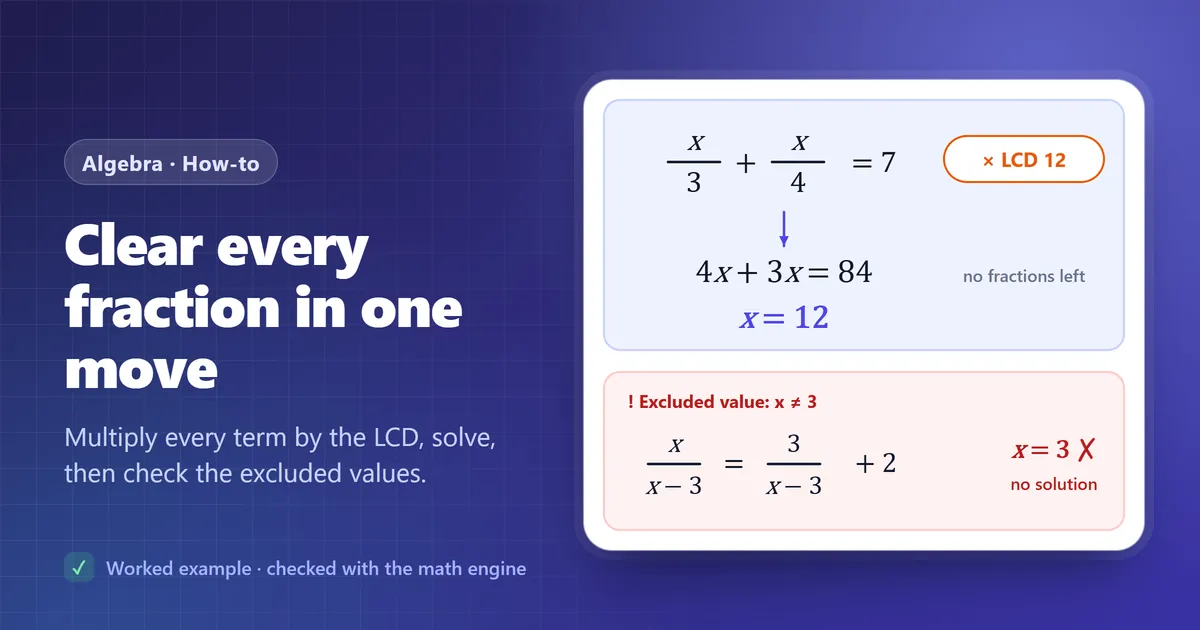
The one move: multiply every term by the LCD
The least common denominator (LCD) is the smallest number that every denominator in the equation divides into. Multiplying every term on both sides by it is allowed — you are doing the same thing to both sides — and it cancels each denominator at once.
- Find the LCD of all the denominators.
- Multiply every term by the LCD, including terms that are not fractions.
- Solve the equation that is left, which no longer has fractions.
- Check the answer in the original equation.
Example 1 · Two fractions, one LCD
The LCD of 3 and 4 is 12. Multiplying by 12 turns x/3 into 4x and x/4 into 3x.
- Multiply both sides by 12This clears the fractions.
- Divide both sides by 7Dividing by the coefficient of x leaves it alone on the left.
Numerators with more than one term need brackets
When a numerator has two terms, multiplying by the LCD must keep them together. Twelve times is , not . The bracket matters even more after a minus sign: the minus in front of applies to the whole numerator, so it becomes .
Writing the bracket first and expanding on the next line costs one extra line and removes the most common sign error in this kind of equation.
Example 2 · Subtracting a two-term numerator
After multiplying by 12: 4(2x − 1) − 3(x + 2) = 12, so 8x − 4 − 3x − 6 = 12 and 5x = 22.
- Multiply both sides by 12This clears the fractions.
- Add 10 to both sidesIsolate the variable term by moving the constant across.
- Divide both sides by 5Dividing by the coefficient of x leaves it alone on the left.
A fraction answer is exact: x = 22/5 is the same number as 4.4.
When the variable is in a denominator
An equation such as is called a rational equation. Before clearing anything, write down the values the variable cannot take — here , because division by zero is undefined. Then the LCD includes the variable itself: the LCD of x and 2 is 2x.
For equations with the variable in several denominators, the equation solver states these restrictions before its first step, the same way you should on paper.
Example 3 · An LCD that contains x
x cannot be 0. Multiplying every term by 2x gives 6 + x = 4x, so x = 2 — allowed, because 2 is not 0.
- State the restrictionsA denominator can never be zero.
- Find the LCDTake each factor of the denominators, at its highest power.
- Multiply every term by the LCDEach term is multiplied by 2x: every denominator cancels.
- Collect like termsCombine the like terms on each side.
- Collect the x terms on one sideMove the letter terms one way and the numbers the other.
- Divide both sides by 3Leaves x on its own.
- Check x = 2left side = 2, right side = 2Both sides of the original equation agree.
Restrictions: x ≠ 0
The check that catches a false answer
Multiplying by an expression that can equal zero can create an answer that does not work in the original equation. Such a value is called an extraneous solution. It is not a mistake in your algebra; it is a side effect of the clearing step, and the check at the end is what removes it.
An excluded value is never an answer
If the only value the algebra gives you is one of the excluded values, the equation has no solution. Write that as the answer — do not keep the excluded value.
Example 4 · A solution that has to be rejected
Here x cannot be 3. Clearing the fractions gives x = 3 + 2(x − 3), which leads to x = 3 — the one value ruled out at the start.
- State the restrictionsA denominator can never be zero.
- Find the LCDTake each factor of the denominators, at its highest power.
- Multiply every term by the LCDEach term is multiplied by (x - 3): every denominator cancels.
- Expand the bracketsMultiply out every bracket, term by term.
- Collect like termsCombine the like terms on each side.
- Collect the x terms on one sideMove the letter terms one way and the numbers the other.
- Reject extraneous solutionsx = 3 would make a denominator zero (or was cancelled away), so it is not a solution.
Restrictions: x ≠ 3
Substituting x = 3 would divide by zero, so the equation has no solution.
How to solve equations with fractions without the usual slips
- Multiply the terms without a denominator too. In the LCD is 6, and the 4 becomes 24.
- Use the least common denominator, not just the product. The product of the denominators always works, but larger numbers mean more arithmetic to get wrong.
- Put brackets around every multi-term numerator before you expand.
- Write the restrictions first whenever the variable appears in a denominator.
Knowing how to solve equations with fractions is half the job; avoiding the slips is the other half. Clearing only some of the fractions is common enough to appear in 10 common algebra mistakes, along with the sign slips that follow a minus in front of a bracket.
If finding the LCD itself is the hard part, the fraction calculator shows how to build it from the factors of each denominator instead of guessing.