


Common algebra mistakes with signs and brackets
- Distributing to the first term only. is . Habit: draw an arrow from the number to every term in the bracket.
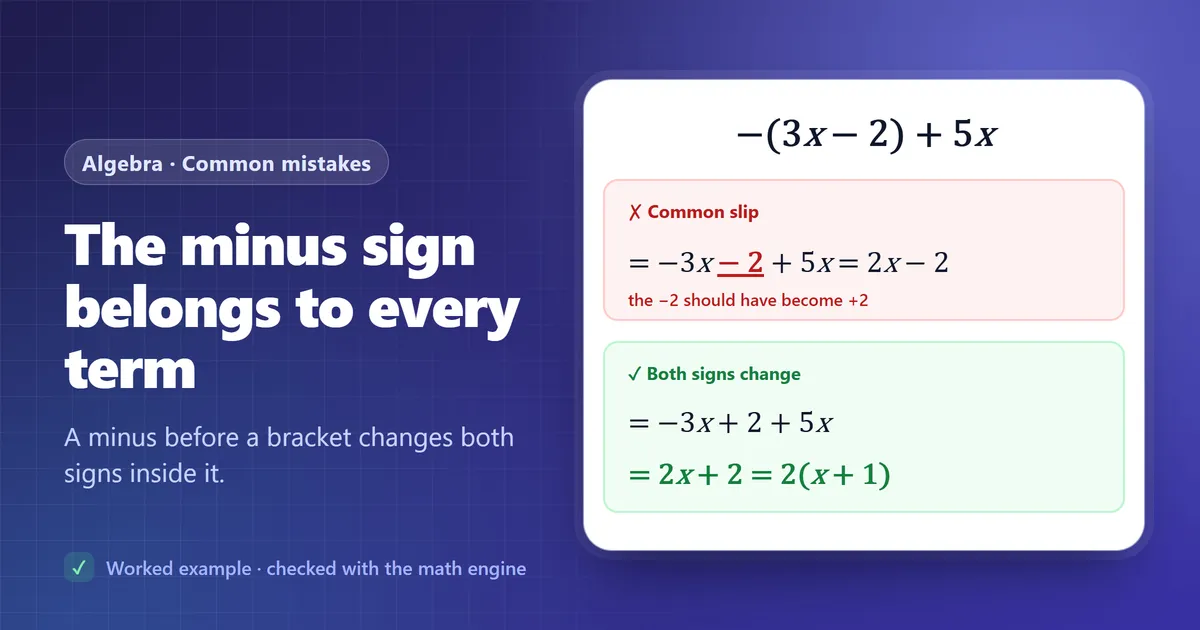
- A minus in front of a bracket. is — every sign inside flips. Habit: rewrite as before distributing.
- Subtracting a negative. . Habit: say "minus a negative is plus" out loud.
Example 1 · A minus before a bracket
Both signs inside the bracket change.
- Combine like termsAdd and subtract matching terms and cancel where possible.
Example 2 · Distributing a negative
The −2 multiplies the x and the 1.
- Expand the bracketsMultiply out each bracket and collect like terms on each side.
- Subtract 2 from both sidesIsolate the variable term by moving the constant across.
- Divide both sides by -2Dividing by the coefficient of x leaves it alone on the left.
Fraction mistakes
- Adding denominators. . Habit: find a common denominator before touching the numerators.
- Clearing only some fractions. (The fraction calculator shows how the LCD is found.) When multiplying through by the LCD, multiply every term. Habit: count the terms before and after.
- Cancelling terms instead of factors. In nothing cancels. Habit: only cancel things that are multiplied.
The whole method for clearing denominators — including what to do when the variable is in one — is in how to solve equations with fractions.
Example 3 · Clearing every fraction
Multiply all three terms by 6 — including the 4.
- Multiply both sides by 6This clears the fractions.
- Subtract x from both sidesWhatever you do to one side, do to the other to keep the equation balanced.
Exponent and root mistakes
- Squaring a sum term by term. ; it is . Habit: write the square as a product, .
- Losing the negative root. means . Habit: write ± the moment you take a square root.
- Misreading . With x = 3, , not 9. Habit: substitute in brackets: .
Squared negatives are one of several order of operations mistakes that change an answer without any algebra going wrong.
One more, hiding inside the list: brackets with a coefficient
A quieter slip deserves its own warning, because it corrupts an answer before the real work even starts: multiplying only the first term inside a bracket. In 3(x − 2), the 3 belongs to both terms — the expansion is 3x − 6, never 3x − 2. The same slip appears with a negative coefficient, where it also flips signs: −2(x + 5) becomes −2x − 10, because the −2 multiplies the +5 as surely as it multiplies the x.
The habit that prevents it costs two seconds: draw an arrow from the coefficient to every term in the bracket before you write anything. If the bracket has three terms, the expansion must have three terms — count them. When you solve an equation built on brackets, the check at the end still protects you, but catching the slip at the first line is cheaper.
Example 4 · Brackets first
Expand to 3x − 6 before moving anything — then the equation is routine.
- Expand the bracketsMultiply out each bracket and collect like terms on each side.
- Subtract x from both sidesWhatever you do to one side, do to the other to keep the equation balanced.
- Add 6 to both sidesIsolate the variable term by moving the constant across.
- Divide both sides by 2Dividing by the coefficient of x leaves it alone on the left.
The tenth mistake: not checking
The tenth mistake makes the other nine expensive: not checking the answer. Substituting your solution into the original equation takes thirty seconds and catches almost every one of these common algebra mistakes.
If your answer is wrong and you cannot see why, paste your working into Check My Math. It finds the first line that does not follow — which is usually one of the nine slips above. For more on writing working that is easy to check, see how to show your work.