


Mistakes 1 and 2: treating PEMDAS as six separate steps
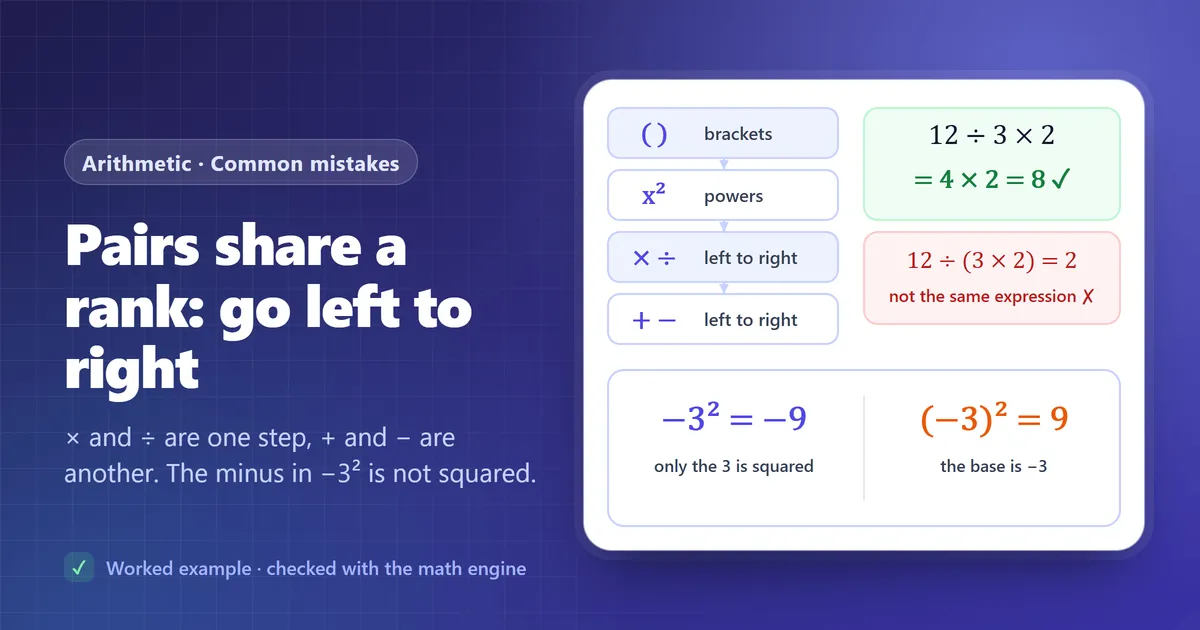
PEMDAS (BODMAS or GEMDAS in some classrooms) lists M before D and A before S, but those letters are pairs, not a ranking. Multiplication and division share one rank, and addition and subtraction share the next. Within a rank, you work from left to right.
- Multiplying before dividing. is 8, not . Habit: underline each × and ÷ and work them in the order they appear.
- Adding before subtracting. is 9, not . Habit: read a subtraction as adding a negative: 10 + (−4) + 3.
Example 1 · Left to right within one rank
The division comes first here only because it is further left.
- Divide (left to right)Order of operations: brackets, powers, × ÷, then + −.
- Multiply (left to right)Order of operations: brackets, powers, × ÷, then + −.
Example 2 · A full expression, rank by rank
The ÷ and × are done left to right before the subtraction: 8 ÷ 4 = 2, then 2 × 2 = 4, then 20 − 4.
- Divide (left to right)Order of operations: brackets, powers, × ÷, then + −.
- Multiply (left to right)Order of operations: brackets, powers, × ÷, then + −.
- Subtract (left to right)Order of operations: brackets, powers, × ÷, then + −.
Mistakes 3 and 4: negative signs and powers
- Squaring the minus sign. means : the exponent belongs to the 3 only. is a different expression. Habit: if the negative is meant to be squared, it must be inside the brackets.
- Substituting a negative without brackets. If , then must be written . Writing instead gives −9 and every line after it is wrong. Habit: every substituted value goes into brackets first.
Example 3 · The exponent belongs to the 3
The power is worked out first, and the minus sign is applied to the result.
- Start with the expressionFollow the order of operations: parentheses first, then powers, then multiplication and division, then addition and subtraction.
- Power 3^2 = 9Powers come before multiplication and division.
Compare (−3)² = 9: with the brackets, the base is −3.
Mistakes 5 and 6: brackets you cannot see
- Ignoring the grouping of a fraction bar. In the bar groups the top and the bottom: work out and completely before dividing. Typed on one line, that grouping has to be written as brackets: 5 + (12 − 4) ÷ 2².
- Moving a power through a bracket. , because the whole product is squared, but , because only the 3 is. Habit: ask what the exponent is touching before you use it.
Example 4 · Brackets, then the power, then divide
The bracket gives 8 and 2² = 4; only then 8 ÷ 4 = 2 and 5 + 2 = 7.
- Inside the brackets: subtract (left to right)Order of operations: brackets, powers, × ÷, then + −.
- Remove the bracketsOrder of operations: brackets, powers, × ÷, then + −.
- Work out 2²A power means the base multiplied by itself that many times.
- Put the values backFactorials and powers come before ×, ÷, + and − in the order of operations.
- Divide (left to right)Order of operations: brackets, powers, × ÷, then + −.
- Add (left to right)Order of operations: brackets, powers, × ÷, then + −.
Example 5 · Squaring a product in brackets
The bracket is worked out first, so the whole 6 is squared: 36, while 2 × 3² is only 18.
- Inside the brackets: multiply (left to right)Order of operations: brackets, powers, × ÷, then + −.
- Remove the bracketsOrder of operations: brackets, powers, × ÷, then + −.
- Work out 6²A power means the base multiplied by itself that many times.
Mistake 7: the viral 6 ÷ 2(1 + 2)
This expression keeps circulating online because readers split between two answers, 1 and 9. Under the convention taught in most US classrooms, a number written next to a bracket is ordinary multiplication, with the same rank as division, so the work goes brackets first and then left to right: .
Some older textbooks, and some calculators, give that implied multiplication a higher priority and return 1. The disagreement is about notation, not arithmetic — which is why careful writers remove it with brackets: or . Habit: if your own expression could be read two ways, add the brackets.
Example 6 · The standard reading
Brackets first gives 6 ÷ 2 × 3; then left to right: 3 × 3 = 9.
- Inside the brackets: add (left to right)Order of operations: brackets, powers, × ÷, then + −.
- Remove the bracketsOrder of operations: brackets, powers, × ÷, then + −.
- Divide (left to right)Order of operations: brackets, powers, × ÷, then + −.
- Multiply (left to right)Order of operations: brackets, powers, × ÷, then + −.
The last of the order of operations mistakes: several ranks in one line
In a long expression, working out the power, the product and the subtraction all in your head at once is where mistake 2 sneaks back in. In , the power and the product give — and that is 17, not . Habit: rewrite the whole expression after each rank, so every line has one kind of operation left to do.
Writing one rank per line prevents most order of operations mistakes at once. That habit is the same idea behind showing your work in math: each line can be checked on its own.
To see any expression worked rank by rank, type it into the simplify calculator. If you already have an answer and want to know where it went wrong, Check My Math points to the first line that does not follow.
Example 7 · One rank per line
Power, then product, then the subtraction and addition from left to right: 18 − 9 + 8 = 17.
- Start with the expressionFollow the order of operations: parentheses first, then powers, then multiplication and division, then addition and subtraction.
- Power 3^2 = 9Powers come before multiplication and division.
- Multiply 4 × 2 = 8Multiplication and division come before addition and subtraction.
- Subtract 18 − 9 = 9Addition and subtraction are done last, left to right.
- Add 9 + 8 = 17Addition and subtraction are done last, left to right.