


What teachers are looking for
The math engine guide shows the difference between deriving an answer and independently checking it, with real substitution and numerical examples.
When a teacher reads your working, they are checking three things: that you chose a valid method, that each line follows from the one before, and that your final answer answers the question asked. A correct answer with no working proves none of these — which is why it often earns less than a wrong answer with clear working.
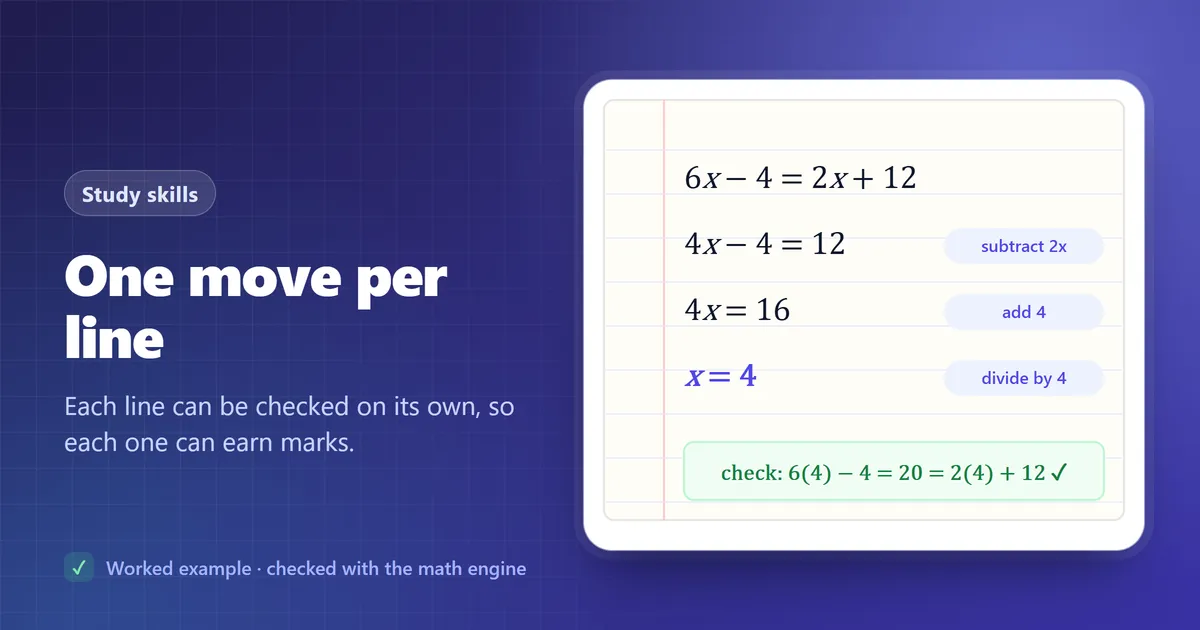
How to show your work in math: one move per line
The simplest rule for clear working: each new line makes exactly one change. Distribute, then collect, then divide — not all three in your head. It feels slower; it is faster, because you stop having to redo problems.
Line the equals signs up vertically when you can, and write a short note in the margin for any non-obvious move ("multiply both sides by 6").
Example 1 · One move per line
Three moves, three lines. Each could be checked on its own.
- Subtract 2x from both sidesWhatever you do to one side, do to the other to keep the equation balanced.
- Add 4 to both sidesIsolate the variable term by moving the constant across.
- Divide both sides by 4Dividing by the coefficient of x leaves it alone on the left.
State conditions and restrictions
For rational equations, write the excluded values at the start — it shows the teacher you know why some answers are impossible, and it reminds you to check at the end.
Example 2 · Restrictions first
Neither denominator may be zero, so x ≠ 0 and x ≠ −2 before any algebra.
- State the restrictionsA denominator can never be zero.
- Find the LCDTake each factor of the denominators, at its highest power.
- Multiply every term by the LCDEach term is multiplied by x(x + 2): every denominator cancels.
- Expand the bracketsMultiply out every bracket.
- Collect the x terms on one sideMove the letter terms one way and the numbers the other.
- Divide both sides by 3Leaves x on its own.
- Check x = 2left side = 3/2, right side = 3/2Both sides of the original equation agree.
Restrictions: x ≠ -2, x ≠ 0
Showing work when you are not sure of the method
The hardest working to write is for a problem you cannot yet solve — and it is also the most valuable. Start with what the question gives you, written as a list: the numbers, the units, the condition that ties them together. Then write what it asks for, as a symbol if you can name one. Teachers award real marks for a correct setup, and a clear setup often shows you the first move once it exists on paper rather than in your head.
If you get stuck halfway, write the stuck point down in words — “I need the height before I can use the area formula” — and move on. That one sentence proves you understood the structure of the problem, gives the teacher something to credit, and gives you an exact place to resume if time remains. Blank space earns nothing and tells nobody anything; honest partial working earns both marks and feedback.
Finish with a sentence
End with the answer to the question, in words and with units: "The rectangle is 10 cm wide and 15 cm long." It shows you read the question, and it often earns a point of its own. That last line is the simplest part of how to show your work in math, and the easiest to forget.
Want to know whether your working holds up? Paste it into Check My Math — it reads one line at a time, so clear working gets the clearest feedback. And if you are unsure what counts as acceptable help, see is using an AI math solver cheating?