
Linear Equations calculator

Linear Equation Calculator for Balanced Solutions

A linear equation calculator isolates the unknown by undoing operations in reverse order. Each equivalent step keeps both sides of the equation balanced.

  • Independent answer checks
  • Every step shown
  • Free, no sign-up

What math problem do you want to solve?

Ctrl+V pastes a screenshot · Shift+Enter: new line (one equation per line)

Try

Typed problems our engine solves stay in your browser. Photos, screenshots, PDFs and AI-helped problems are processed by our AI service — privacy.

For example, subtracting 3 from both sides of 2x + 3 = 11 leaves 2x = 8. Substitution can then check the proposed value against the original equation.

Linear Equations · worked example✓ Verified
3(x−4)+2=2x+53(x - 4) + 2 = 2x + 5
Expand the brackets
3x−10=2x+53x - 10 = 2x + 5
Subtract 2x from both sides
x−10=5x - 10 = 5
Add 10 to both sides
x=15x = 15
x=15x = 15Re-checked by a second engine
Linear Equations · worked example✓ Verified
0.2x+1.5=0.5x−30.2x + 1.5 = 0.5x - 3
Multiply both sides by 10
2x+15=5x−302x + 15 = 5x - 30
Subtract 5x from both sides
−3x+15=−30-3x + 15 = -30
Subtract 15 from both sides
−3x=−45-3x = -45
x=15x = 15Re-checked by a second engine
Linear Equations · worked example✓ Verified
x4−1=2\frac{x}{4} - 1 = 2
Multiply both sides by 4
x−4=8x - 4 = 8
Add 4 to both sides
x=12x = 12
x=12x = 12Re-checked by a second engine

1 / 3

Quick examples

Study guide

How to solve linear equations

A linear equation has one variable raised to the first power — something like 2x + 3 = 11. Your goal is always the same: get x alone on one side.

Start by moving the constant term. Whatever you do to one side, do to the other — that keeps the equation balanced. In 2x + 3 = 11, subtract 3 from both sides to get 2x = 8.

Next, undo the multiplication. Divide both sides by the coefficient of x: 2x = 8 becomes x = 4. If the coefficient is already 1, you are done after step one.

When x appears on both sides, collect the x-terms on one side first. For 5x − 7 = 2x + 8, subtract 2x from both sides, then continue as usual.

Always check by substituting back: 2(4) + 3 = 11 ✓. Our solver does this check automatically — that is what the ✓ Verified badge means.

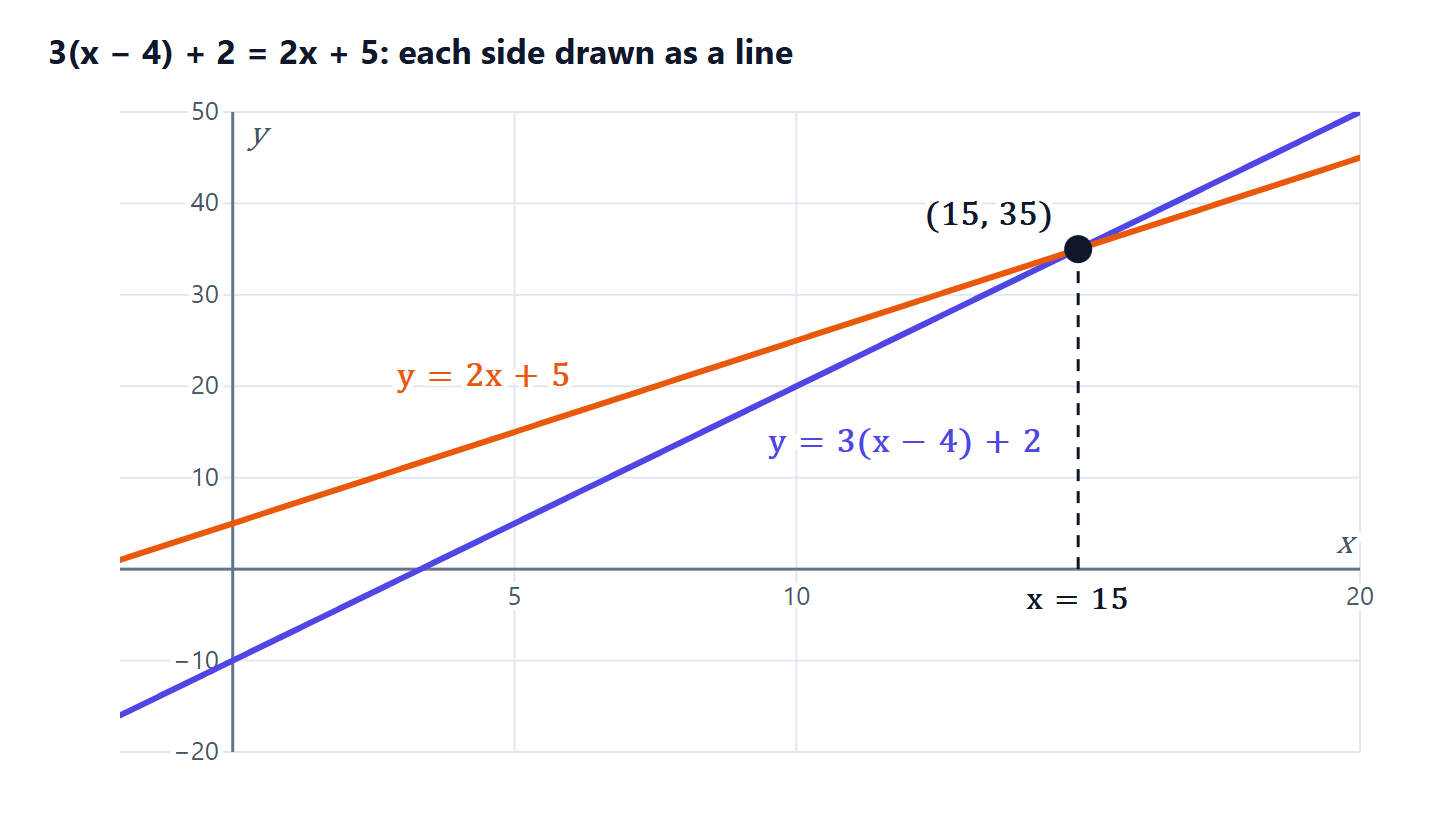
Graph of the two sides of 3(x − 4) + 2 = 2x + 5 as straight lines, y = 3(x − 4) + 2 and y = 2x + 5, crossing at the point (15, 35); a dashed line drops from the crossing to x = 15 on the x-axis.
Each side of 3(x − 4) + 2 = 2x + 5 drawn as a line. They cross where both sides are equal: x = 15, where each side is 35.

Checking the result

How this result is checked

For a numerical root, the math engine substitutes the displayed value into the original equation; identities and contradictions use their own checks.

Messier equations

What the linear equation calculator accepts

Textbook linear equations rarely arrive as tidy as 2x+3=112x + 3 = 11. Three kinds of clutter come up again and again, and each has one standard first move:

  • Brackets: distribute first. In 3(x−4)+2=2x+53(x - 4) + 2 = 2x + 5, the 3 multiplies both the x and the −4, giving 3x−12+23x - 12 + 2.
  • Fractions: multiply every term on both sides by the least common denominator. x4−1=2\frac{x}{4} - 1 = 2 becomes x−4=8x - 4 = 8 after multiplying by 4 — including the terms that had no fraction.
  • Decimals: either work with them directly or multiply through by 10 or 100 to make every coefficient a whole number. 0.2x+1.5=0.5x−30.2x + 1.5 = 0.5x - 3 times 10 is 2x+15=5x−302x + 15 = 5x - 30.

After that clean-up the equation is in the familiar shape, and the same two moves finish it: collect the x-terms on one side, then divide by the coefficient. Equations with an x² term go to the quadratic equation calculator, and the AI equation solver gathers every equation type in one place.

Special cases

When every number works — or none does

Occasionally the x-terms cancel completely. What is left tells you everything:

  • A true statement such as 2=22 = 2 means the equation is an identity: every value of x satisfies it. The answer is "infinitely many solutions" (or "all real numbers").
  • A false statement such as 0=50 = 5 means a contradiction: no value of x works. The answer is "no solution".

These are real answers, not mistakes. The calculator recognizes both and checks the claim — for an identity, by confirming the two sides agree at many values of x.

Word problems that lead to a linear equation are easier to start in the AI math solver: it proposes the equation it reads in the story and waits for you to confirm it before solving. The guide on how to solve word problems shows the same setup by hand.

Reference

The moves that keep an equation balanced

Every step in a linear solution is one of these, applied to both sides at once.

Add or subtract

a=b  ⟺  a+c=b+ca = b \iff a + c = b + c

Moves a constant or an x-term across the equals sign.

Multiply

a=b  ⟺  ac=bc(c≠0)a = b \iff ac = bc \quad (c \neq 0)

Clears fractions when c is the common denominator.

Divide

ax=b  ⟺  x=ba(a≠0)ax = b \iff x = \frac{b}{a} \quad (a \neq 0)

The last step: undo the coefficient.

Distribute

a(b+c)=ab+aca(b + c) = ab + ac

The sign in front of the bracket goes to every term inside.

Worked examples

Linear Equations, worked step by step

Each solution below is the solver’s own working, checked before it was published. Press “Solve it live” to open it in the calculator above.

Example 1 · Brackets and x on both sides

3(x−4)+2=2x+53(x - 4) + 2 = 2x + 5

Distribute, tidy the left side, then move the 2x across.

x=15x = 15
✓ Verified

Independent check

x=15:3⋅(15−4)+2=2⋅15+5x = 15:\quad 3\cdot \left(15-4\right)+2 = 2\cdot 15+5
  1. Expand the brackets
    3x−10=2x+53x - 10 = 2x + 5
    Multiply out each bracket and collect like terms on each side.
  2. Subtract 2x from both sides
    x−10=5x - 10 = 5
    Whatever you do to one side, do to the other to keep the equation balanced.
  3. Add 10 to both sides
    x=15x = 15
    Isolate the variable term by moving the constant across.

Example 2 · A fraction coefficient

x4−1=2\frac{x}{4} - 1 = 2

One fraction in the equation: multiplying through by 4 removes it.

x=12x = 12
✓ Verified

Independent check

x=12:124−1=2x = 12:\quad \frac{12}{4}-1 = 2
  1. Multiply both sides by 4
    x−4=8x - 4 = 8
    This clears the fractions.
  2. Add 4 to both sides
    x=12x = 12
    Isolate the variable term by moving the constant across.

Example 3 · Decimals

0.2x+1.5=0.5x−30.2x + 1.5 = 0.5x - 3

Decimal coefficients behave exactly like whole numbers; only the arithmetic needs care.

x=15x = 15
✓ Verified

Independent check

x=15:0.2⋅15+1.5=0.5⋅15−3x = 15:\quad 0.2\cdot 15+1.5 = 0.5\cdot 15-3
  1. Multiply both sides by 10
    2x+15=5x−302x + 15 = 5x - 30
    This clears the fractions.
  2. Subtract 5x from both sides
    −3x+15=−30-3x + 15 = -30
    Whatever you do to one side, do to the other to keep the equation balanced.
  3. Subtract 15 from both sides
    −3x=−45-3x = -45
    Isolate the variable term by moving the constant across.
  4. Divide both sides by -3
    x=15x = 15
    Dividing by the coefficient of x leaves it alone on the left.

Example 4 · An identity

2(x+1)=2x+22(x+1) = 2x + 2

After distributing, both sides are identical — so what happens to x?

Infinitely many solutions
✓ Verified

Every value of x works. Writing "x = 0" or "no solution" here would both be marked wrong.

  1. Expand the brackets
    2x+2=2x+22x + 2 = 2x + 2
    Multiply out each bracket and collect like terms on each side.
  2. Subtract 2x from both sides
    2=22 = 2
    Whatever you do to one side, do to the other to keep the equation balanced.
  3. Infinitely many solutions
    true for every x\displaystyle \allowbreak \text{true for every } x
    Both sides are the same, so every value works.

Avoid these

Common linear equations mistakes

  • Distributing to one term

    3(x−4)3(x - 4) is 3x−123x - 12, not 3x−43x - 4. Draw an arrow from the 3 to every term in the bracket.

  • Moving a term without changing its sign

    Subtracting 2x from both sides removes +2x from the right; on the left it appears as −2x. "Moving" is shorthand — the operation is what matters.

  • Clearing only some fractions

    Multiplying by the common denominator applies to every term, including whole numbers. Forgetting the −1 in x4−1=2\frac{x}{4} - 1 = 2 is the classic slip.

  • Dividing by the wrong sign

    From −3x=12-3x = 12, divide by −3, not 3: x=−4x = -4.

  • Stopping at 0 = 0

    An equation that reduces to a true statement has infinitely many solutions; one that reduces to a false one has none. Neither means "x = 0".

  • Checking against your own line

    Substitute into the original equation. If you copied it wrong in line one, every later line will agree with the copy and still be wrong.

FAQ

Linear Equations calculator FAQ

How do you solve a linear equation step by step?

Move constants to one side and x-terms to the other (doing the same operation to both sides), then divide by the coefficient of x. For 2x+3=11: subtract 3 → 2x=8, divide by 2 → x=4.

What if x is on both sides of the equation?

Collect the x-terms on one side first. In 5x−7=2x+8, subtract 2x from both sides to get 3x−7=8, then add 7 and divide by 3: x=5.

How can I check my answer is right?

Substitute it back into the original equation. If both sides match, the answer is correct. Our solver runs this substitution check on every answer before awarding the ✓ Verified badge.

What does "no solution" mean?

If simplifying leads to a false statement like 0 = 5, no value of x can satisfy the equation. If it leads to 0 = 0, every value of x works — infinitely many solutions.

How do I solve a linear equation with fractions?

Multiply every term on both sides by the least common denominator of all the fractions. The fractions disappear and you finish as usual. The calculator shows this step explicitly — try x/4 - 1 = 2.

What is the difference between a linear equation and a linear expression?

An equation has an equals sign and is solved for x; an expression like 3x−123x - 12 has no equals sign and can only be simplified. To simplify an expression, use the simplify expression calculator.

Can it solve for a letter other than x?

Yes. Any single letter works as the variable — 12 + 0.5m = 20 is solved for m, and the steps use that letter throughout. Two equations in two unknowns go to the system of equations calculator.

Your own linear equations problem

Brackets, fractions or decimals — type the equation exactly as it appears in your book, and the linear equation calculator isolates x one move at a time.