


How to solve word problems in five steps
- Read the question sentence first. It tells you the unknown and its units.
- Let x be one thing, in words. "Let x = the number of adult tickets." Never "x = tickets".
- Write every other quantity in terms of x. If there are 20 tickets in total, the child tickets are .
- Find the one fact with a number — a total, a perimeter, a sum of angles — and write it as an equation.
- Solve, then answer in words with units, and check the answer makes sense in the story.
Example 1: angles in a triangle
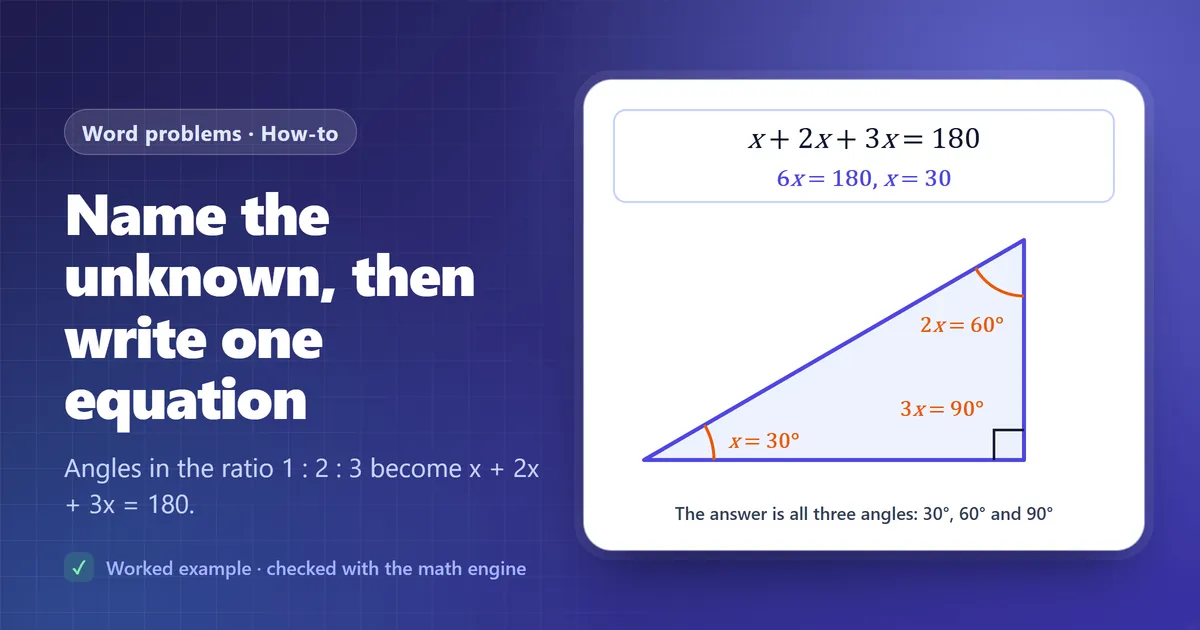
Story: the angles of a triangle are in the ratio 1 : 2 : 3. Find them. Setup: call the smallest angle x; the others are 2x and 3x; the angles of a triangle add up to 180°.
Example 1 · Triangle angles
- Divide both sides by 6Dividing by the coefficient of x leaves it alone on the left.
So the angles are 30°, 60° and 90° — the answer is all three, not x = 30.
Example 2: ticket sales
Story: a school sold 20 tickets. Adult tickets cost $8 and child tickets $5. The total was $130. How many adult tickets were sold? Setup: let n = adult tickets, so 20 − n are child tickets; revenue is 8n + 5(20 − n).
Example 2 · Two prices, one total
- Expand the bracketsMultiply out each bracket and collect like terms on each side.
- Subtract 100 from both sidesIsolate the variable term by moving the constant across.
- Divide both sides by 3Dividing by the coefficient of n leaves it alone on the left.
10 adult tickets and 10 child tickets. Check: 80 + 50 = 130.
Example 3: a rectangle’s perimeter
Story: a rectangle’s length is 5 cm more than its width, and its perimeter is 50 cm. Find its dimensions. Setup: width x, length x + 5; perimeter is twice width plus twice length.
Example 3 · Perimeter
- Expand the bracketsMultiply out each bracket and collect like terms on each side.
- Subtract 10 from both sidesIsolate the variable term by moving the constant across.
- Divide both sides by 4Dividing by the coefficient of x leaves it alone on the left.
Width 10 cm, length 15 cm.
Sequences hide inside stories too
Not every story becomes an equation. Some describe a pattern growing by the same step each time: seats added per row, tiles per border, savings per week. The tell is a list of numbers with equal gaps, or a story where “each next one” adds a fixed amount. Those are arithmetic sequences, and the question almost always asks for a far-out term — the 10th row, the 25th week — where counting one by one is a trap.
Name the two numbers that run the pattern: the first term and the gap. The term in position n is the first term plus (n − 1) gaps, because you only jump between terms, not past the last one. That off-by-one is the whole difficulty of these stories; the AI word problem solver states the first term and the gap before it computes anything, so you can check its reading of the story against yours.
Example 4 · A growing pattern
First term 5, gap 4 — the 10th term needs nine jumps, not ten.
- Find the common differenceEach term is the one before plus the same amount, so this is an arithmetic sequence.
- Use aₙ = a₁ + (n − 1)dStart from the first term and add d once for every step after it.
- Substitute n = 10Put the term number into the formula.
When you are stuck on the setup
Try plugging in a guess. If you guess 12 adult tickets, revenue would be 8(12) + 5(8) = 136 — too much. Writing out a guess like that shows you exactly what the equation is, with x in place of the 12. Guessing first is a legitimate part of how to solve word problems, not a shortcut.
You can also paste the whole story into the word problem solver: it proposes the equation and waits for you to confirm it, so you can compare its setup with yours before anything is solved. For harder systems with two unknowns, see the systems calculator.