
Fractions calculator

Fraction Calculator That Shows Every Step

The fraction calculator adds and subtracts fractions with exact results. It converts unlike denominators before combining the numerators.

  • Independent answer checks
  • Every step shown
  • Free, no sign-up

What math problem do you want to solve?

Ctrl+V pastes a screenshot · Shift+Enter: new line (one equation per line)

Try

Typed problems our engine solves stay in your browser. Photos, screenshots, PDFs and AI-helped problems are processed by our AI service — privacy.

To multiply fractions, multiply their numerators and denominators separately. To divide, multiply by the reciprocal of the nonzero divisor, then reduce the result.

Fractions · worked example✓ Verified
213−1562 \frac{1}{3} - 1 \frac{5}{6}
Find a common denominator
2+13=63+132 + \frac{1}{3} = \frac{6}{3} + \frac{1}{3}
Add the numerators
63+13=73\frac{6}{3} + \frac{1}{3} = \frac{7}{3}
Find a common denominator
1+56=66+561 + \frac{5}{6} = \frac{6}{6} + \frac{5}{6}
12\frac{1}{2}Re-checked by a second engine
Fractions · worked example✓ Verified
712+518\frac{7}{12} + \frac{5}{18}
Find a common denominator
712+518=2136+1036\frac{7}{12} + \frac{5}{18} = \frac{21}{36} + \frac{10}{36}
Add the numerators
2136+1036=3136\frac{21}{36} + \frac{10}{36} = \frac{31}{36}
State the answer
712+518=3136\frac{7}{12}+\frac{5}{18} = \frac{31}{36}
3136\frac{31}{36}Re-checked by a second engine
Fractions · worked example✓ Verified
523\frac{5}{\frac{2}{3}}
Multiply by the reciprocal
5÷23=5×32=1525 \div \frac{2}{3} = 5 \times \frac{3}{2} = \frac{15}{2}
State the answer
523=152\frac{5}{\frac{2}{3}} = \frac{15}{2}
152\frac{15}{2}Re-checked by a second engine

1 / 3

Quick examples

Study guide

How to solve fractions

To add or subtract fractions, the denominators must match. Find the least common denominator (LCD) — the smallest number both denominators divide into — then rewrite each fraction with it.

For 3/4 + 1/6, the LCD of 4 and 6 is 12. Rewrite: 3/4 becomes 9/12 and 1/6 becomes 2/12. Now add the numerators: 9/12 + 2/12 = 11/12.

Multiplying is simpler: multiply straight across — numerators times numerators, denominators times denominators. 2/3 × 9/4 = 18/12, then simplify.

Dividing by a fraction means multiplying by its reciprocal: flip the second fraction and multiply. So 1/2 ÷ 3/4 becomes 1/2 × 4/3 = 4/6 = 2/3.

Always simplify at the end by dividing numerator and denominator by their greatest common divisor. 18/12 simplifies to 3/2 — the solver never leaves an unsimplified answer.

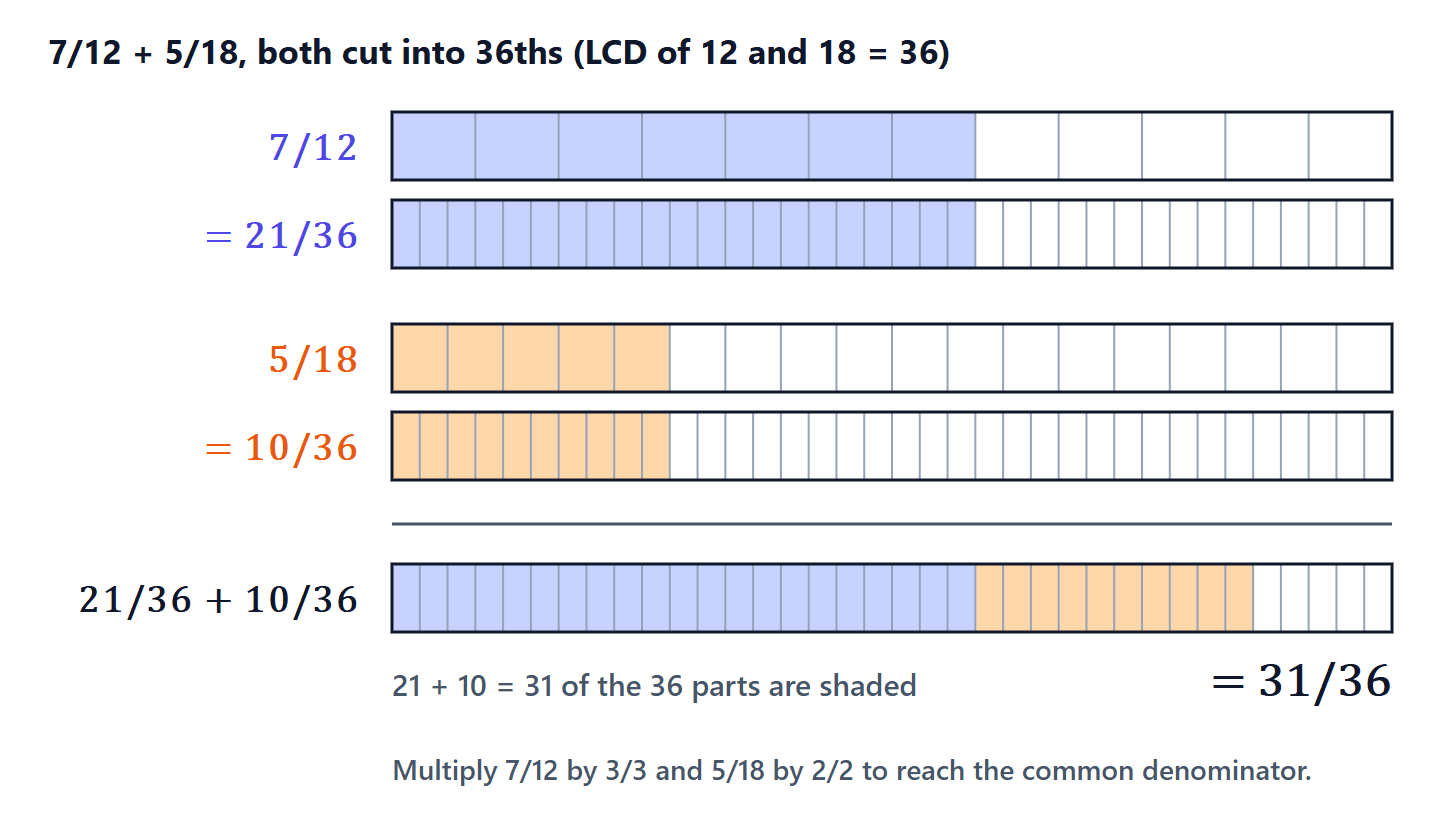
Bar model: 7/12 is a bar of 12 parts with 7 shaded, redrawn as 21 of 36 parts; 5/18 is a bar of 18 parts with 5 shaded, redrawn as 10 of 36 parts; together they fill 31 of 36 parts, so 7/12 + 5/18 = 31/36.
Adding 7/12 + 5/18 with a bar model: cut both bars into 36ths (the least common denominator), then count the shaded parts: 21 + 10 = 31, so the sum is 31/36.

Checking the result

How this result is checked

Exact fraction arithmetic keeps the denominators through the calculation. The math engine uses a separate value check for supported results before marking them Verified.

Typing fractions

Mixed numbers and division in the fraction calculator

  • A fraction is a slash: 7/12.
  • A mixed number is a whole number, a space, then the fraction: 2 1/3 means two and one third.
  • To divide by a fraction, bracket it: 5 / (2/3). Without brackets, 5/2/3 is read left to right as (5÷2)÷3(5 \div 2) \div 3.
  • Multiplication can be * or ×: 4/9 * 3/8.

If something could be read two ways — 1/2x is the usual one — the calculator shows both readings and asks before it solves.

Fractions that sit inside an equation or a word problem belong in the AI math solver, which reads the whole question and keeps the arithmetic in exact fractions rather than rounded decimals.

Least common denominator

Finding the LCD without guessing

Multiplying the two denominators always gives a common denominator, but often not the least one, and a larger denominator means more reducing at the end. A reliable way to find the least one:

  1. Write each denominator as a product of primes: 12=22⋅312 = 2^2 \cdot 3 and 18=2⋅3218 = 2 \cdot 3^2.
  2. Take every prime that appears, at its highest power: 22⋅322^2 \cdot 3^2.
  3. Multiply: 4⋅9=364 \cdot 9 = 36. That is the LCD of 12 and 18.

Then rewrite each fraction over 36 by multiplying top and bottom by the same number: 712=2136\frac{7}{12} = \frac{21}{36} and 518=1036\frac{5}{18} = \frac{10}{36}.

Reference

The four operations

Add / subtract

ab±cd=ad±bcbd\frac{a}{b} \pm \frac{c}{d} = \frac{ad \pm bc}{bd}

Then reduce — or use the LCD from the start for smaller numbers.

Multiply

ab⋅cd=acbd\frac{a}{b} \cdot \frac{c}{d} = \frac{ac}{bd}

Cancel common factors across before multiplying.

Divide

ab÷cd=ab⋅dc\frac{a}{b} \div \frac{c}{d} = \frac{a}{b} \cdot \frac{d}{c}

Keep, change, flip.

Mixed to improper

n ab=nb+abn\,\frac{a}{b} = \frac{nb + a}{b}

213=732\tfrac{1}{3} = \tfrac{7}{3}.

Worked examples

Fractions, worked step by step

Each solution below is the solver’s own working, checked before it was published. Press “Solve it live” to open it in the calculator above.

Example 1 · Unlike denominators

712+518\frac{7}{12} + \frac{5}{18}

The LCD is 36, not 12 × 18 = 216.

3136\frac{31}{36}
✓ Verified

Independent check

712+518=3136\frac{7}{12}+\frac{5}{18} = \frac{31}{36}
  1. Find a common denominator
    712+518=2136+1036\frac{7}{12} + \frac{5}{18} = \frac{21}{36} + \frac{10}{36}
    The least common denominator of 12 and 18 is 36.
  2. Add the numerators
    2136+1036=3136\frac{21}{36} + \frac{10}{36} = \frac{31}{36}
    With the same denominator, only the numerators combine.
  3. State the answer
    712+518=3136\frac{7}{12}+\frac{5}{18} = \frac{31}{36}
    The original calculation equals the simplified result.

Example 2 · Subtracting mixed numbers

213−1562 \frac{1}{3} - 1 \frac{5}{6}

Convert to improper fractions first; that avoids borrowing from the whole number.

12\frac{1}{2}
✓ Verified

Independent check

2+13−(1+56)=122+\frac{1}{3}-\left(1+\frac{5}{6}\right) = \frac{1}{2}
  1. Find a common denominator
    2+13=63+132 + \frac{1}{3} = \frac{6}{3} + \frac{1}{3}
    The least common denominator of 1 and 3 is 3.
  2. Add the numerators
    63+13=73\frac{6}{3} + \frac{1}{3} = \frac{7}{3}
    With the same denominator, only the numerators combine.
  3. Find a common denominator
    1+56=66+561 + \frac{5}{6} = \frac{6}{6} + \frac{5}{6}
    The least common denominator of 1 and 6 is 6.
  4. Add the numerators
    66+56=116\frac{6}{6} + \frac{5}{6} = \frac{11}{6}
    With the same denominator, only the numerators combine.
  5. Find a common denominator
    73−116=146−116\frac{7}{3} - \frac{11}{6} = \frac{14}{6} - \frac{11}{6}
    The least common denominator of 3 and 6 is 6.
  6. Subtract the numerators
    146−116=36\frac{14}{6} - \frac{11}{6} = \frac{3}{6}
    With the same denominator, only the numerators combine.
  7. Simplify the fraction
    36=12\frac{3}{6} = \frac{1}{2}
    Divide the top and bottom by their greatest common divisor, 3.
  8. State the answer
    2+13−(1+56)=122+\frac{1}{3}-(1+\frac{5}{6}) = \frac{1}{2}
    The original calculation equals the simplified result.

Example 3 · Multiplying with cancelling

49⋅38\frac{4}{9} \cdot \frac{3}{8}

The 3 and the 9 share a factor of 3, and the 4 and the 8 share a factor of 4.

16\frac{1}{6}
✓ Verified

Independent check

49⋅38=16\frac{\frac{4}{9}\cdot 3}{8} = \frac{1}{6}
  1. Multiply numerators and denominators
    49×3=129\frac{4}{9} \times 3 = \frac{12}{9}
    Multiply straight across: top × top, bottom × bottom.
  2. Simplify the fraction
    129=43\frac{12}{9} = \frac{4}{3}
    Divide the top and bottom by their greatest common divisor, 3.
  3. Multiply by the reciprocal
    43÷8=43×18=424\frac{4}{3} \div 8 = \frac{4}{3} \times \frac{1}{8} = \frac{4}{24}
    Dividing by a fraction is the same as multiplying by its flip.
  4. Simplify the fraction
    424=16\frac{4}{24} = \frac{1}{6}
    Divide the top and bottom by their greatest common divisor, 4.
  5. State the answer
    (49)⋅38=16\frac{(\frac{4}{9}) \cdot 3}{8} = \frac{1}{6}
    The original calculation equals the simplified result.

Example 4 · Dividing by a fraction

523\frac{5}{\frac{2}{3}}

Dividing by two thirds is the same as multiplying by three halves.

152\frac{15}{2}
✓ Verified

Independent check

523=152\frac{5}{\frac{2}{3}} = \frac{15}{2}

The answer 15/2 can also be written as the mixed number 7127\tfrac{1}{2}.

  1. Multiply by the reciprocal
    5÷23=5×32=1525 \div \frac{2}{3} = 5 \times \frac{3}{2} = \frac{15}{2}
    Dividing by a fraction is the same as multiplying by its flip.
  2. State the answer
    523=152\frac{5}{\frac{2}{3}} = \frac{15}{2}
    The original calculation equals the simplified result.

Example 5 · Improper fraction to mixed number

convert 175 to a mixed number\text{convert } \frac{17}{5} \text{ }\allowbreak \text{to }\allowbreak \text{a }\allowbreak \text{mixed }\allowbreak \text{number}

Divide the top by the bottom: 17 ÷ 5 is 3 with remainder 2, so the whole part is 3 and the remainder stays over 5.

3253\tfrac{2}{5}
✓ Verified

Independent check

3×5+2=173 \times 5 + 2 = 17
  1. Divide 17 by 5
    17÷5=3 remainder 2\displaystyle 17 \div 5 = 3\ \allowbreak \text{remainder}\ 2
    The whole number is how many times the bottom goes into the top; the remainder is left over.
  2. Write the remainder over the denominator
    175=325\frac{17}{5} = 3\tfrac{2}{5}
    The remainder 2 over 5, next to the whole number.

Avoid these

Common fractions mistakes

  • Adding the denominators

    12+13\frac{1}{2} + \frac{1}{3} is not 25\frac{2}{5}. Only numerators are added, and only once the denominators match.

  • Flipping the wrong fraction

    In division, flip the second fraction (the divisor), never the first.

  • Forgetting the whole number

    Converting 2132\tfrac{1}{3} to 13\tfrac{1}{3} drops the 2. Multiply it by the denominator and add: 73\tfrac{7}{3}.

  • Changing only the bottom

    To rewrite 712\frac{7}{12} over 36, multiply the top by 3 as well — otherwise the value changes.

  • Not reducing at the end

    1836\frac{18}{36} is correct but unfinished. Divide top and bottom by their greatest common factor.

  • Cancelling across a plus sign

    In 2+32\frac{2 + 3}{2} the 2s do not cancel. Only factors of the whole top and bottom cancel — one of the most common algebra mistakes.

FAQ

Fractions calculator FAQ

How do you add fractions with different denominators?

Find the least common denominator, rewrite each fraction with it, then add the numerators. For 3/4+1/6 the LCD is 12: 9/12+2/12=11/12.

How do you divide fractions?

Flip the second fraction (take its reciprocal) and multiply. 1/2 ÷ 3/4 = 1/2 × 4/3 = 4/6 = 2/3.

How do you simplify a fraction?

Divide the top and bottom by their greatest common divisor. For 18/12 the GCD is 6, so it simplifies to 3/2.

What is a mixed number and when do I need one?

A mixed number like 1½ combines a whole number with a fraction. Improper fractions such as 3/2 can be written as 1½ — both are correct, and teachers usually accept either.

Does the fraction calculator give decimals?

It gives the exact fraction in lowest terms, which is what most fraction homework asks for. If you need a decimal, divide the numerator by the denominator afterwards.

Can it handle negative fractions?

Yes. Type the minus sign in front, -3/4, or in brackets, (-3)/4. The sign is carried through every step.

Can I use it for fractions with variables?

Yes — algebraic fractions such as (x+1)/(x-2) = 3 are solved with restrictions shown. For simplifying them, see the simplify calculator.

Your own fractions problem

Mixed numbers, unlike denominators, division — type the fractions as they appear and get the result in lowest terms.