
Inequalities calculator

Inequality Calculator for Finding Solution Sets

An inequality calculator solves supported comparisons and shows the resulting solution set. Its steps track operations applied to both sides.

  • Independent answer checks
  • Every step shown
  • Free, no sign-up

What math problem do you want to solve?

Ctrl+V pastes a screenshot · Shift+Enter: new line (one equation per line)

Try

Typed problems our engine solves stay in your browser. Photos, screenshots, PDFs and AI-helped problems are processed by our AI service — privacy.

Multiplying or dividing by a negative reverses the inequality sign. Unlike linear equations, the result is often an interval rather than a single value.

Inequalities · worked example✓ Verified
3(x+2)≤5x−43(x + 2) \le 5x - 4
Find the boundary: expand the brackets
3x+6=5x−43x + 6 = 5x - 4
Subtract 5x from both sides
−2x+6=−4-2x + 6 = -4
Subtract 6 from both sides
−2x=−10-2x = -10
x≥5x \ge 5Re-checked by a second engine
Inequalities · worked example✓ Verified
4−3x≥104 - 3x \ge 10
Find the boundary: expand the brackets
−3x+4=10-3x + 4 = 10
Subtract 4 from both sides
−3x=6-3x = 6
Divide both sides by -3
x=−2x = -2
x≤−2x \le -2Re-checked by a second engine
Inequalities · worked example✓ Verified
2(x−1)<3x+42(x - 1) < 3x + 4
Find the boundary: expand the brackets
2x−2=3x+42x - 2 = 3x + 4
Subtract 3x from both sides
−x−2=4-x - 2 = 4
Add 2 to both sides
−x=6-x = 6
x>−6x > -6Re-checked by a second engine

1 / 3

Quick examples

Study guide

How to solve inequalities

An inequality works like an equation, except the answer is a range of x-values instead of one value. Solve it in two stages: find the boundary, then decide which side counts.

Stage one: replace the inequality sign with = and solve normally. For 2x + 3 > 7, the boundary comes from 2x + 3 = 7, giving x = 2.

Stage two: test a point on each side. Try x = 3: 2(3)+3 = 9 > 7 ✓, so the solution is everything above the boundary: x > 2.

The golden rule: multiplying or dividing by a negative flips the sign. In 5 − x < 2, isolating x means dividing by −1, so < becomes > and the answer is x > 3 — not x < 3.

Graph your answer on a number line: an open circle for > and <, a filled circle for ≥ and ≤, with the arrow pointing toward the solution side.

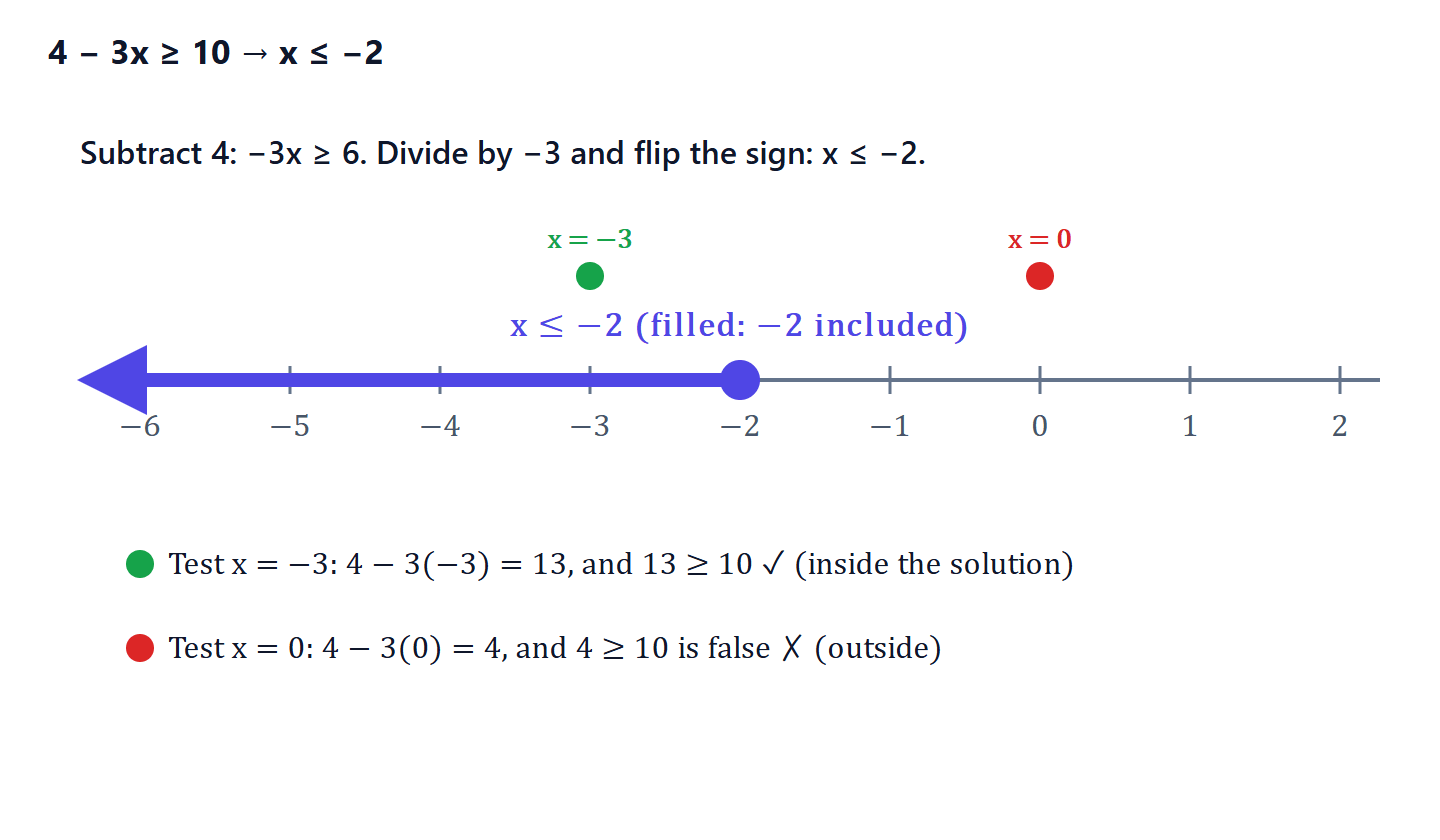
Number line for 4 − 3x ≥ 10: a filled dot at −2 with the line shaded to the left, showing x ≤ −2; the test point x = −3 gives 13, which satisfies the inequality, and x = 0 gives 4, which does not.
Solving 4 − 3x ≥ 10 means dividing by −3, which flips ≥ to ≤: x ≤ −2. The filled dot means −2 itself is included; the test points confirm the side.

Checking the result

How this result is checked

The math engine checks supported inequality solution sets against the original relation. Domain exclusions still apply: an undefined denominator cannot become an allowed boundary.

Typing

How to type signs in the inequality calculator

  • Less than and greater than: < and >.
  • Less than or equal / greater than or equal: <= and >= (or ≤ and ≥ from the Math Keyboard).
  • Brackets and fractions work as in equations: x/2 + 1 > 4, 3(x + 2) <= 5x - 4.

Writing the answer

Three ways to write the same solution

Your class may ask for the answer as an inequality, on a number line or in interval notation. For x≥5x \geq 5:

  • Inequality: x≥5x \geq 5.
  • Number line: a filled (closed) dot at 5, shaded to the right. An open dot would mean 5 itself is excluded, as for x>5x > 5.
  • Interval notation: [5,∞)[5, \infty). A square bracket includes the endpoint; a round bracket excludes it. Infinity always gets a round bracket.

The calculator gives the inequality form; converting it is a one-line step you should be able to do from the table above.

Answers with two bounds or two pieces — a chain such as −3<2x+1≤7-3 < 2x + 1 \leq 7, or a pair joined by "or" — follow the same bracket rules, and the guide to how to solve compound inequalities works through each kind.

If the inequality is one line of a bigger question, the AI math solver takes the whole problem in one box and states whether its final answer was independently checked.

Reference

Rules for working with inequalities

Add or subtract

a<b⇒a+c<b+ca < b \Rightarrow a + c < b + c

Direction unchanged.

Multiply by a positive

a<b, c>0⇒ac<bca < b,\ c > 0 \Rightarrow ac < bc

Direction unchanged.

Multiply by a negative

a<b, c<0⇒ac>bca < b,\ c < 0 \Rightarrow ac > bc

Direction flips.

Swap sides

a<b  ⟺  b>aa < b \iff b > a

Reading right to left also flips the symbol.

Worked examples

Inequalities, worked step by step

Each solution below is the solver’s own working, checked before it was published. Press “Solve it live” to open it in the calculator above.

Example 1 · Dividing by a negative

4−3x≥104 - 3x \ge 10

The −3 in front of x means the sign will flip at the last step.

x≤−2x \le -2
✓ Verified

Independent check

x=−3:4−3⋅(−3)≥10holdsx = -3:\quad 4-3\cdot \left(-3\right) \ge 10\quad \text{holds}
x=−2:4−3⋅(−2)≥10holdsx = -2:\quad 4-3\cdot \left(-2\right) \ge 10\quad \text{holds}
  1. Find the boundary: expand the brackets
    −3x+4=10-3x + 4 = 10
    The boundary is where the two sides are equal — solve it like an equation first.
  2. Subtract 4 from both sides
    −3x=6-3x = 6
    Isolate the variable term by moving the constant across.
  3. Divide both sides by -3
    x=−2x = -2
    Dividing by the coefficient of x leaves it alone on the left.
  4. Test x = -1: does not satisfy the inequality
    7 ≥ 10 is false
    x = -1 makes the inequality false, so the solution is the OTHER side of the boundary.
  5. Write the solution set
    x≤−2x \le -2
    The variable coefficient is negative, so the direction flips when isolating it — just like dividing by a negative.

Example 2 · x on both sides

2(x−1)<3x+42(x - 1) < 3x + 4

Collect the x-terms on the side where they stay positive to avoid a flip, or on either side and flip if needed.

x>−6x > -6
✓ Verified

Independent check

x=−7:2⋅(−7−1)<3⋅(−7)+4does not holdx = -7:\quad 2\cdot \left(-7-1\right) < 3\cdot \left(-7\right)+4\quad \text{does not hold}
x=−6:2⋅(−6−1)<3⋅(−6)+4does not holdx = -6:\quad 2\cdot \left(-6-1\right) < 3\cdot \left(-6\right)+4\quad \text{does not hold}
  1. Find the boundary: expand the brackets
    2x−2=3x+42x - 2 = 3x + 4
    The boundary is where the two sides are equal — solve it like an equation first.
  2. Subtract 3x from both sides
    −x−2=4-x - 2 = 4
    Whatever you do to one side, do to the other to keep the equation balanced.
  3. Add 2 to both sides
    −x=6-x = 6
    Isolate the variable term by moving the constant across.
  4. Divide both sides by -1
    x=−6x = -6
    Dividing by the coefficient of x leaves it alone on the left.
  5. Test x = -5: satisfies the inequality
    -12 < -11 is true
    x = -5 makes the inequality true, so the side beyond the boundary in that direction is the solution.
  6. Write the solution set
    x>−6x > -6
    The variable coefficient is negative, so the direction flips when isolating it — just like dividing by a negative.

Example 3 · A fraction

x2+1>4\frac{x}{2} + 1 > 4

Multiplying both sides by a positive 2 keeps the direction.

x>6x > 6
✓ Verified

Independent check

x=5:52+1>4does not holdx = 5:\quad \frac{5}{2}+1 > 4\quad \text{does not hold}
x=6:62+1>4does not holdx = 6:\quad \frac{6}{2}+1 > 4\quad \text{does not hold}
  1. Find the boundary: multiply both sides by 2
    x+2=8x + 2 = 8
    The boundary is where the two sides are equal — solve it like an equation first.
  2. Subtract 2 from both sides
    x=6x = 6
    Isolate the variable term by moving the constant across.
  3. Test x = 7: satisfies the inequality
    4.5 > 4 is true
    x = 7 makes the inequality true, so the side beyond the boundary in that direction is the solution.
  4. Write the solution set
    x>6x > 6
    Everything on the true side of the boundary satisfies the inequality.

Example 4 · Brackets and an "or equal to"

3(x+2)≤5x−43(x + 2) \le 5x - 4

Distribute, collect, divide — and keep the "equal to" part.

x≥5x \ge 5
✓ Verified

Independent check

x=4:3⋅(4+2)≤5⋅4−4does not holdx = 4:\quad 3\cdot \left(4+2\right) \le 5\cdot 4-4\quad \text{does not hold}
x=5:3⋅(5+2)≤5⋅5−4holdsx = 5:\quad 3\cdot \left(5+2\right) \le 5\cdot 5-4\quad \text{holds}

Check with a test point: x = 6 gives 24 ≤ 26, true; x = 4 gives 18 ≤ 16, false.

  1. Find the boundary: expand the brackets
    3x+6=5x−43x + 6 = 5x - 4
    The boundary is where the two sides are equal — solve it like an equation first.
  2. Subtract 5x from both sides
    −2x+6=−4-2x + 6 = -4
    Whatever you do to one side, do to the other to keep the equation balanced.
  3. Subtract 6 from both sides
    −2x=−10-2x = -10
    Isolate the variable term by moving the constant across.
  4. Divide both sides by -2
    x=5x = 5
    Dividing by the coefficient of x leaves it alone on the left.
  5. Test x = 6: satisfies the inequality
    24 ≤ 26 is true
    x = 6 makes the inequality true, so the side beyond the boundary in that direction is the solution.
  6. Write the solution set
    x≥5x \ge 5
    The variable coefficient is negative, so the direction flips when isolating it — just like dividing by a negative.

Avoid these

Common inequalities mistakes

  • Forgetting to flip

    Dividing −3x≥6-3x \geq 6 by −3 gives x≤−2x \leq -2. Leaving it as ≥ reverses the whole solution set.

  • Flipping when adding a negative

    Only multiplying or dividing by a negative flips the sign. Adding or subtracting never does.

  • Open vs closed dots

    A closed dot means "included" (≤, ≥); open means "excluded" (<, >).

  • Writing 5 < x as x < 5

    Swapping sides flips the symbol: 5<x5 < x is x>5x > 5.

  • Testing only the boundary

    The boundary value tells you where the solution changes; test a point on one side to see which side is shaded.

  • Square brackets on infinity

    Infinity is never included: [5,∞)[5, \infty), not [5,∞][5, \infty].

FAQ

Inequalities calculator FAQ

When does the inequality sign flip?

When you multiply or divide both sides by a negative number. In 5−x<2, dividing by −1 flips < to >, giving x>3.

How do you solve 2x+3>7 step by step?

First solve the boundary 2x+3=7 → x=2. Then test x=3: 9>7 is true, so the solution is x>2.

What is the difference between > and ≥?

> excludes the boundary value; ≥ includes it. On a number line, > gets an open circle and ≥ gets a filled circle at the boundary.

How do I check an inequality answer?

Pick a value inside your solution set and one outside. The inside value must satisfy the inequality and the outside one must fail. The solver tests both automatically.

Can it solve compound inequalities like −2 < 3x + 1 ≤ 7?

Yes. A linear compound inequality keeps both bounds: the solver works on all three parts at once, reverses both signs when it divides by a negative number, and checks the answer with test points at each boundary and between them. Two inequalities joined by "and" or "or" work the same way. Type them exactly as written.

Can it solve quadratic inequalities?

Simple ones like x2−4<0x^2 - 4 < 0 are handled by the full engine in the browser. The method is to find the roots of the matching quadratic equation, then test one point in each interval between them.

Your own inequalities problem

Type the inequality as it appears — the inequality calculator flags the exact step where the sign flips.