


Use the graphing calculator as a second method
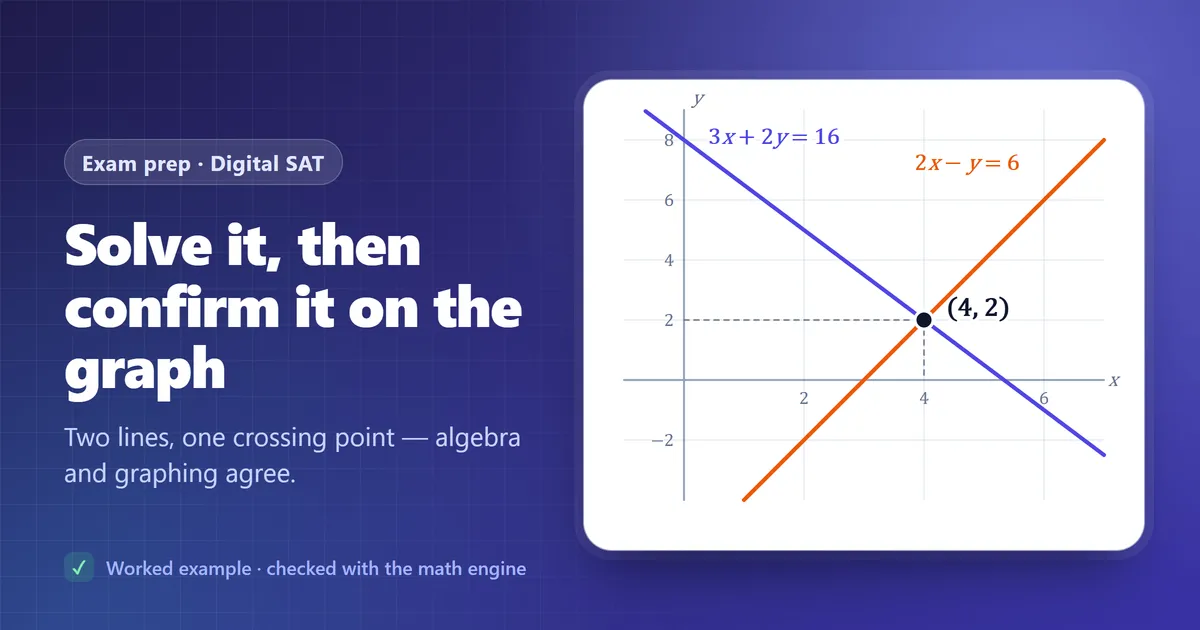
The built-in graphing calculator is available on every math question. Its best use is not arithmetic but checking: type both sides of an equation as separate graphs and read off where they cross. If the intersection matches your algebra, move on with confidence.
For systems, graph both equations and click the intersection point — it shows the coordinates. For a quadratic, the x-intercepts are the roots.
Example 1 · A system: algebra, then a graph
Solve by elimination, then confirm by graphing both lines — they cross at the same point.
- Label the equationsWork with the two equations as a labeled pair.
- Multiply equation (1) by 2This lines up the x coefficients for elimination.
- Multiply equation (2) by 3Now both equations have the same x coefficient.
- Subtract to eliminate xThe x terms cancel, leaving one equation in y alone.
- Solve for yDivide by the coefficient, just like a one-variable equation.
- Substitute y = 2 into equation (1)With one variable known, the other follows from either original equation.
- Solve for xSimplify to get the final value.
Protect Module 1
Your Module 1 result decides whether Module 2 is the harder or easier version, and only the harder version leads to top scores. That makes careless errors in Module 1 unusually expensive. Re-read every question once before answering, and check what it is asking for — many ask for or rather than .
Student-produced responses
About a quarter of SAT Math questions have no answer choices. Two habits help: substitute your answer back into the original equation before entering it, and enter fractions or decimals exactly as allowed (a fraction like 7/2 is fine; do not round unless told to).
Example 2 · A quick percent equation
40% of a number is 18 — divide, then sanity-check: 40% of 45 is 18.
- Multiply both sides by 5This clears the fractions.
- Divide both sides by 2Dividing by the coefficient of x leaves it alone on the left.
Budget your minutes by module, not by question
Thirty-five minutes for twenty-two questions works out at roughly ninety-five seconds each, but the questions are not priced equally. The first third of a module is mostly quick wins; the last few questions can honestly cost three minutes. Students who treat every question as worth the same ninety-five seconds donate their easiest marks to the hardest problems.
Work in two passes instead. First pass: answer everything you can do cleanly, and flag — do not wrestle — anything that stalls past a minute. Second pass: spend the time you banked on the flagged questions, starting with the ones closest to finished. A flagged question you return to with fresh eyes is worth more than the same minutes spent staring, because the error in a stuck attempt is usually visible only after you have looked away.
The last of the SAT Math tips: practice where the points are
Algebra and Advanced Math together make up about seven in ten SAT Math questions. Of all the SAT Math tips here, this one moves a score most: linear equations, systems, quadratics and functions are where practice pays off fastest; the SAT Math page lists the domains with links to the calculator for each.
Factorable quadratics like the one below appear often — sometimes asking for the roots, sometimes for their sum or product.
Example 3 · A typical quadratic
Roots 7 and 3, so their sum is 10 and their product 21 — matching −b/a and c/a.
- Identify a, b and cThe coefficients decide which method works best.
- Factor the quadraticThe discriminant is a perfect square, so the quadratic splits into two linear factors.
- Set each factor to zeroA product is zero exactly when one of its factors is zero.