


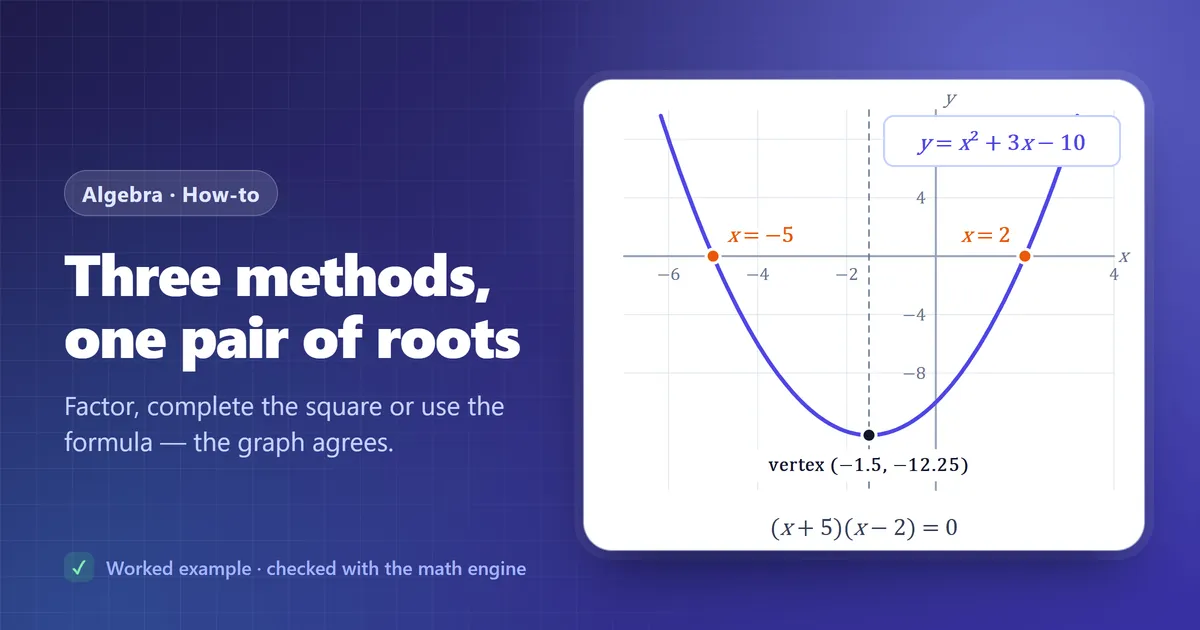
Step 0: get the equation into standard form
Every method starts from . Move every term to one side so the other side is zero, and write the terms in order of power. Then note a, b and c with their signs — a lost minus sign here is the most common reason a correct method gives a wrong answer.
If all three coefficients share a factor, divide it out first. becomes : the same roots, smaller numbers.
Method 1: factoring
Factoring is fastest when the roots are whole numbers. For , look for two numbers that multiply to c and add to b. Write the quadratic as two brackets, then use the zero-product rule: if a product is zero, one of its factors is zero.
For , the numbers are 5 and −2 (5 × −2 = −10 and 5 + (−2) = 3).
Example 1 · Factoring
Find the pair, write the brackets, set each to zero.
- Identify a, b and cThe coefficients decide which method works best.
- Factor the quadraticThe discriminant is a perfect square, so the quadratic splits into two linear factors.
- Set each factor to zeroA product is zero exactly when one of its factors is zero.
Method 2: completing the square
Completing the square rewrites the left side as a perfect square plus a constant. It works on every quadratic, and it is how the quadratic formula is derived — which is why many teachers insist you learn it.
- Move the constant to the right: .
- Halve the coefficient of x and square it: . Add it to both sides: .
- Write the left side as a square: .
- Take square roots — both signs: , so or .
The solver uses this method when you choose Completing the square from the Method menu on the quadratic calculator. Below is the same equation in its default working.
Example 2 · One equation, any method
Compare the solver’s steps with the completing-the-square working above: the roots are the same.
- Identify a, b and cThe coefficients decide which method works best.
- Factor the quadraticThe discriminant is a perfect square, so the quadratic splits into two linear factors.
- Set each factor to zeroA product is zero exactly when one of its factors is zero.
Method 3: the quadratic formula
When nothing factors neatly, the formula always works:
Substitute carefully, with brackets around negatives, and simplify the square root if you can. The quantity under the root, , is the discriminant: if it is not a perfect square, the roots are irrational and should be left in exact form.
Example 3 · The formula
Here , not a perfect square — so the roots involve .
- Identify a, b and cThe coefficients decide which method works best.
- Apply the quadratic formulaThe formula gives the exact values for any quadratic.
- Calculate the discriminantThe discriminant sits under the square root.
- Substitute and simplifySimplify the square root (pull out square factors). As decimals: x ≈ 3.302775638, -0.3027756377.
How to solve quadratic equations: which method to use
When you decide how to solve quadratic equations on a test, a quick decision rule helps:
- No x-term ()? Isolate and take square roots, or use the difference of squares.
- Small whole-number coefficients, and you can spot the pair within ten seconds? Factor.
- Discriminant not a perfect square, or large coefficients? Use the formula.
- Asked for vertex form or told to complete the square? Complete the square.
Whatever you choose, check by substituting each root into the original equation. Our equation solver does exactly that before it marks an answer verified.