


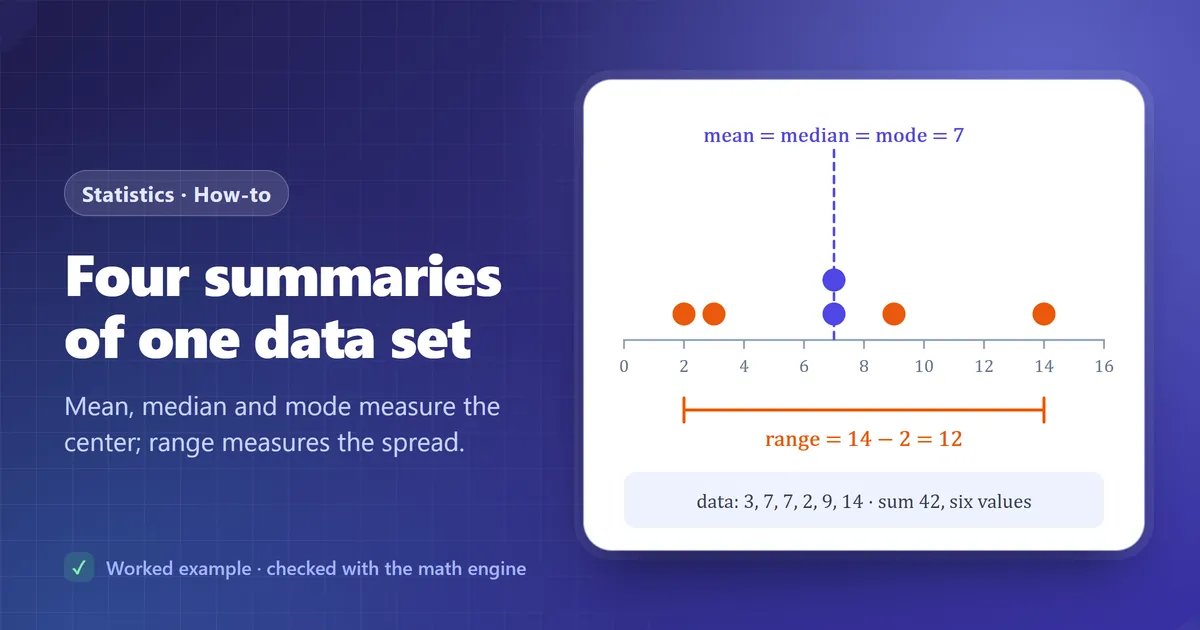
The mean: share it out equally
Add the values and divide by how many there are. The mean is the "fair share" value: if everyone had the same amount, it is how much each would get.
Example 1 · Mean of six values
Six values adding to 42.
- Add the valuesThe mean is the total shared out equally.
- Count the valuesThere are this many numbers.
- Divide the total by the countMean = sum ÷ count.
The median: the middle value
Sort the data first. With an odd number of values, the median is the middle one. With an even number, it is the average of the two middle values.
The median is not pulled around by extreme values, which is why house prices and incomes are usually reported as medians.
Example 2 · Median of an odd-sized list
Sorted: 3, 6, 9, 15, 21 — the third value is the middle.
- Sort the valuesThe median is the middle of the ordered list.
- Take the middle valueWith 5 values, the middle one is number 3.
The mode and the range
The mode is the value that appears most often. A data set can have one mode, several, or none. The range is not an average at all: it is the spread, largest minus smallest.
Example 3 · The mode
7 appears three times — more than any other value.
- Count how often each value appearsThe mode is the most frequent value.
- Pick the most frequentIt appears 3 times.
Example 4 · The range
Largest 19, smallest 5.
- Find the smallest and largest valuesScan the list (or sort it) for the two ends.
- Largest minus smallestThe range measures the spread.
Mean, median, mode: which average should you use?
- Mean for data without extreme values, when every value should count: test scores in a class, daily temperatures.
- Median when there are outliers or the data is skewed: incomes, house prices, reaction times.
- Mode for categories or the most popular choice: shoe sizes sold, favorite subjects.
For measures of spread beyond the range — variance and standard deviation, and the difference between the sample and population versions — see the statistics solver, which states which one it used. Data questions are also a full domain of SAT Math.
Reading the question: which average is it hinting at?
Exam questions rarely name the average they want — mean, median, mode or range — outright. “Typical”, “representative” and “central” are hints, not answers, and the right choice depends on the story wrapped around the numbers. If one value is wildly larger than the rest — a single jackpot salary among office wages — the writer is usually steering you to the median, because the mean would describe nobody in the room.
Watch for the reverse hint as well: a question that gives you the mean and the count, then asks for a missing value, is testing whether you know the mean is a repackaged total. Multiply first, subtract what you have, and the missing number falls out. And when a list has an even count of values, expect the median to be a halfway number that never appears in the data — that is normal, not a sign you sorted wrongly.
Example 5 · A median that is not in the list
Six values, already sorted: the median is the average of 15 and 16.
- Sort the valuesThe median is the middle of the ordered list.
- Average the two middle valuesWith 6 values there are two middle ones.